SIERRA de LOJA.

IF YOU ARE LOOKING AT THE BLOG ON A PHONE PLEASE CHANGE TO WEB VIEW AT BOTTOM OF PAGE AS IT WILL LOOK BETTER.

Friday, 26 June 2009

Cacín Valley, Granada Province.

The Butterflies

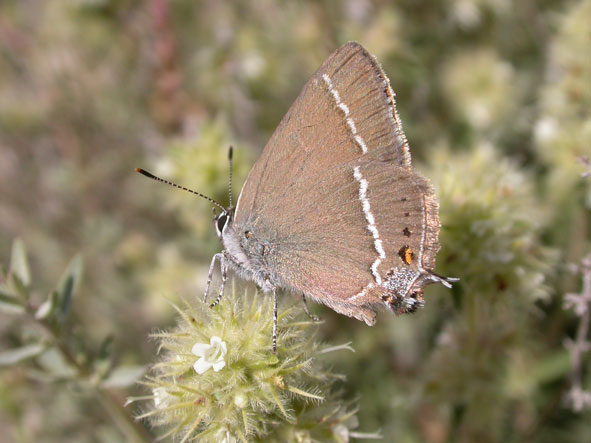
Blue-spotted Hairstreak (Satyrium spini).
Throughout the day, butterfly species were on the wing and several interesting species were noted including Blue-spotted Hairstreak (Satyrium spini) and Panoptes Blue (Pseudophilotes panoptes) were both seen feeding on the spiny flowers of Field Eryngo (Eryngium campestre) whilst several Iberian Scarce Swallowtail (Iphiclides feisthameli) flew rapidly past looking for the larger flowers of the thistle plants.
Panoptes Blue (Pseudophilotes panoptes).
Scarce Swallowtail (Chupaleches / Iphichides podalirius feistameli).
Also seen in good numbers were Common / Southern Blue (Polyommatus icarus / celina) and Long-tailed Blues (Lampides boeticus), Spanish Brown Argus (Aricia cramera), Meadow Brown (Maniola jurtina), Small Heath (Coenonympha pamphilus), Cleopatra (Gonepteryx rhamni), Southern Gatekeeper (Pyronia cecilia) and several species of White including Bath (Pontia daplidice), Small (Artogeia rapae) and Large (Bpieris brassicae).

Tuesday, 23 June 2009

Cattle Egrets, Huetor Tajar, Granada Province.

Unseasonal flock.

Whilst driving towards Granada on the A92 a flock of 17 Western Cattle Egrets (Garcilla Bueyera / Bubulcus ibis) were seen feeding in a harvested Lucerne (Medicago sativa) field near Moraleda de Zafayona. 
This is not an uncommon sight for most of the year, but during the height of summer only the odd singleton is seen.

Tuesday, 16 June 2009

Genil Valley, Sierra Nevada, Granada Province.

Orchids and Butterflies.

Small-leaves Helleborine (Epipactis microphylla).
The main point of this visit was to check on the flowering progress of two species of Epipactis, both growing in the mixed broad leaved woodlands typical of this valley.
The first was Small-leaves Helleborine (Epipactis microphylla) and I quickly found 5 spikes all in different stages of flowering, some starting to go over whilst 2 were still in bud.
Epipactis fageticola.
The next plant was Epipactis fageticola at a site I found last year, where there were 17 spikes with quite a way to go before they were to flower but at a new site to me near the microphylla, 4 more plants were seen in a much brighter position and a single plant had 2 flowers just about open. 
Comma (Polygonia c-album).
4 plus spikes of Dactylorhiza elata ssp sesquipedalis were also in perfect condition a little further along the road in a damp flush.
Long-tailed Blue (Lampides boeticus).
Marsh Fritillary (Euphydryas aurinia).
At a point further down in the valley where the road crosses the Rio Genil several butterfly species were seen, these included Comma (Polygonia c-album), Spanish Gatekeeper (Pyronia bathseba), False Ilex Hairstreak (Satyrium esculi), Small Copper (Lycaena phlaeas), Speckled Wood (Pararge aegeria), Clouded Yellow (Colias croceus), Marsh Fritillary (Euphydryas aurinia), Southern Blue (Polyommatus celina), Small Skipper (Thymelicus sylvestris), Long-tailed Blue (Lampides boeticus), Brown Argus (Aricia agestis), Small White (Artogeia rapae) and Spanish Marbled White (Melanargia ines).

Sunday, 7 June 2009

RAM and Charca de Suárez, Motril, Granada Province.

Strange birds at sea.

Sandwich Tern (Charrán Patinegro / Sterna sandvicensis).
Juan Perez and I made our monthly visit to a headland near Motril to carry out the RAM sea bird survey. The morning was going well with a few Cory (Pardela Cenicienta / Calonectris diomedea) and Balearic Shearwaters (Pardela Balear / Puffinus mauretanicus), Northern Gannet (Alcatraz Atlántico / Morus bassanus) and Audouin's Gulls (Gaviota de Audouin / Larus audouinii) passing by. 
Then the birds of the day were seen moving east about 500 meters offshore, a group of 13 Greater Flamingo's (Flamenco Común / Phoenicopterus ruber) a new bird for my Granada list made quite an unusual sight flying low over the sea. 
A couple of Peregrine Falcons (Halcón Peregrino / Falco peregrinus), Pallid Swifts (Vencejo Pálido / Apus pallidus), Western Cattle Egret (Garcilla Bueyera / Bubulcus ibis), Sandwich (Charrán Patinegro / Sterna sandvicensis), Gull Billed (Charrán Piconegro / Gelochelidon nilotica) and Little Terns (Charrancito Común / Sterna albifrons) were also recorded.

Audouin's Gulls (Gaviota de Audouin / Larus audouinii).
The next stop was at the port of Motril where we spent some time recording the ring numbers of the many Audouin's Gulls roosting.
Charca de Suárez was quiet bird wise but Great Cormorant (Cormorán Grande / Phalacrocorax carbo), Little Grebe (Zapullin Común / Tachybaptus ruficollis), Little Egret (Garceta Común / Egretta garzetta), Grey (Garza Real / Ardea cinerea) and Squacco Herons (Garcilla Cangrejera / Ardeola ralloides) were seen and Western Swamp-hen (Calamon Común /Porphyrio porphyrio) was heard.

Saturday, 6 June 2009

Dragonflies at Charca de Suárez, Granada Province.

Two more new species.

Blue / Common Emperor (Anax imperator).
After the RAM seabird survey Juan and I went to Charca de Suárez near Motril, the wind was strong but several species of Dragonfly were seen. 
The first was a nice ♂ Blue / Common Emperor (Anax imperator) which was sheltering from the winds in some vegetation, a common species at this site and on most areas of water with some marginal plants. 
It is the largest and most powerful flying of the Odonata seen in this region, and some territorial battles between the males are to the death. 
Female Violet Dropwing (Trithemis annulata).
The Emperor was quickly followed by ♂ and ♀ Violet Dropwings (Trithemis annulata) hunting from cut off stalks of Fennel growing along the walk ways around the reserve. 
This species gets its Dropwing name from the position it takes at rest, with the wings thrust forward and down and the abdomen held high. 
Several ♂ Broad Scarlet's (Crocothemis erythraea) were seen and what I first thought was a ♀ of the same species was the next insect to be photographed, but later it was identified as a ♀ Keeled Skimmer (Orthetrum coerulescens) the first of two new dragonfly species seen today. 
♀ Keeled Skimmer (Orthetrum coerulescens).
I then notice an all black insect with a very active flight skimming low through the vegetation in a drier area of the marsh. 
I again managed to get shots of an Imm ♂, but this was enough to identify it as a Black Percher (Diplacodes lefebvrii) the second new species for me. 
The ♂ was all black, which means it was probably quite an old insect, younger ♂♂ have some yellow markings along the side of the abdomen, it has a restricted range still in Iberia, mainly coastal in the south but is expected to expand north.
Black Percher (Diplacodes lefebvrii).
Iberian Bluetail (Ischnura graellsii) and Small Red-eyed Damselfly (Erythromma viridulum) were also seen along with Migrant Hawker (Aeshna mixta) all of which avoided the camera completely.
Wednesday, 3 June 2009

Sierra de Almijara, Granada Province.

A spectacular show of Marsh Orchids.

The Rio.
After quite a drive out in to the wild's, Jayne and I got to the site where Ian Philips from Malaga had seen Common Twayblade (Listera ovata) and Robust Marsh Orchid (Dactylorhiza eleta) in the past.
Common Twayblade (Listera ovata).
The Marsh Orchid was quite a sight with about 60 spikes growing on the banks of a clear mountain stream with several of the plants reaching a height of near 3 feet and were possibly of the subspecies sesquipedalis. 
The prize here though were two spikes of the Common Twayblade a new orchid species in Spain for me, they may not be the smartest or brightest Orchid species I have ever seen, but the two spikes were very nice. 
Robust Marsh Orchid (Dactylorhiza eleta).
Usually growing to between 20 and 60 cm, these plants were on the small side at about 30 cms, the spike usually only has two subopposite large oval leaves, but a small third leaf can rarely be present.
Also seen here were Speckled Wood (Pararge aegeria) and Painted Lady (Vanessa cardui) and a very large species of pond skater.

New Damselfly, Sierra de Almijara, Granada Province.

Large Red Damselfly (Pyrrhosoma nymphula).

Male Large Red Damselfly (Pyrrhosoma nymphula).
Several of the Odonata species were on the wing along a small mountain stream in the Sierra de Almijara. I only managed to photograph males but several insects were seen in tandem. This was the only Dragonfly species seen at the site which was surprising as the site looked ideal.

Saturday, 30 May 2009

A day in the Sierra Nevada with SEO, Granada Province.

The Genil Valley.

Rio Genil in a wooded valley.
A group of 13 set off on a wild life walk along the Rio Genil in the wooded valleys in the north of the National Park. The walk started at Estacion de Maitena just east of Guejar-Sierra and followed the Rio Genil for quite a few KMs. Eurasian Sparrowhawk (Gavilán Común / Accipiter nisus), European Serin (Verdecillo / Serinus serinus), Red-rumped Swallow (Golondrina Dáurica / Hirundo daurica) and Eurasian Crag Martin (Avión Roquero / Ptyonoprogne rupestris) were all seen before leaving the road and following the disused tram line. Spotted Flycatcher (Papamoscas Gris / Muscicapa striata), Eurasian Blue Tit (Herrerillo Común / Parus caeruleus) and Common Chaffinch (Pinzón Vulgar / Fringilla coelebs) were all feeding in a small group of Sweet Chestnut Trees (Astanea sativa) along the way. 
Digitalis obsura.
Pyrenean Oak (Quercus pyrenaica) and Yew (Taxus baccata) were both found near the first Venta and just before we left the tram way to join la Vereda de la Estrella we found several spikes of Robust Marsh Orchid (Dactylorhiza elata) in a track side flush along with Digitalis obsura and Dianthus Pungens. Acer granatense, Acer monspessulanum and Sorbus torminalis were three new tree species I had not seen before in Granada Province which were all described by our walk leader Jorge Garzón.  
Western Bonelli’s Warbler (Mosquitero Papialbo / Phylloscopus bonelli), European Robin (Petirrrojo / Erithacus rubecula), Eurasian Blackcap (Curruca Capirotada / Sylvia atricapilla) and Common Nightingale (Ruisenor Común / Luscinia megarhynchos) all sang from the scrub growing on the slopes.
Pyrenean Oak (Quercus pyrenaica).
We stopped for lunch on the bank of the Rio Genil where a White-throated Dipper (Mirlo Acuático / Cinclus cinclus) put in an appearance up stream from us.
The weather then took a turn for the worse, thunder, lightening, hail, rain and snow all took their turn before the sun returned. 
The storm rumbled away behind us for the rest of the day but did not cause any problems, so we added Eurasian Golden Oriole (Oropéndola / Oriolus oriolus), Rock Bunting (Escribano Montesino / Emberiza cia), Eurasian Wren (Chochin / Troglodytes troglodytes), Eurasian Jay (Arrendajo / Garrulus glandarius), Blue-Rock Thrush (Roquero Solitario / Monticola solitarius), Common Kingfisher (Martin Pescador / Alcedo atthis) and Red-billed Chough (Chova Piquirroja / Pyrrhocorax pyrrhocorax) to the day's list on the way back to the cars. 
Some snow on the  Sierra.
Many more species were seen during the day (too many to list here) and every one had a most enjoyable walk.

A day in the Sierra Nevada with SEO, Granada Province, (part two).

Some of the Butterflies in Sierra Nevada.

Mallow Skipper (Carcharodus alceae).
Whilst on the walk, a good number of butterflies were seen in the sunshine that was with us for most of the day. Many species were seen collecting minerals and water from the small flows of water along the pathways.
False Mallow / Mallow Skipper (Carcharodus tripolina / alceae).
Many False Mallow / Mallow (Carcharodus tripolina / alceae) and Small Skippers (Thymelicus sylvestris) and Marsh Fritillaries (Euphydryas aurinia) were found at these wet flushes.  
Large (Pieris brassicae), Small (Artogeia rapae) and Black-Veined Whites (Aporia crataegi), Spanish Gatekeeper (Pyronia bathseba) and Clouded Yellow (Colias croceus) were all seen commonly flying amongst the trees.
Cardinal Fritillary (Argynnis pandora).
Small Copper (Lycaena phlaeas), Spanish Marbled White (Melanargia ines), Provence Orange-tip (Anthocharis euphenoides),  and Common Orange-tip (Anthocharis cardamines), Painted Lady (Vanessa cardui), Wall Brown (Lasiommata megera), Small Tortoiseshell (Aglais urticae), Spanish Festoon (Zerynthia rumina), Iberian Scarce Swallowtail (Iphiclides feisthameli) the southern form of this species, Cardinal Fritillary (Argynnis pandora), Southern Blue (Polyommatus  celina) which is also quite different from the Northern European form (female having blue upper wings), Bath White (Pontia daplidice), Speckled Wood (Pararge aegeria) also differing slightly from Northern forms by having Orange instead of cream spots and Southern Brown Argus (Aricia cramera) were all also seen during the day.
Southern Blue (Polyommatus celina).

Friday, 22 May 2009

Orchids in Sierra de las Nieves, Malaga Province.

Orchis cazorlensis and Limodorum trabutianum.

Orchis cazorlensis
I drove over to Ronda with Jayne and her sister where we picked Brenda Jones up on the way past her house. 
Brenda and I dropped Jayne and Barbara off in the centre of the town for some shopping and continued on to Sierra de las Nieves for a few hours looking for Orchids, our first spot was at a site given to us by one of the local rangers in low road side scrub on some very rocky ground where we first found several spikes of Man Orchid (Aceras anthropophorum). 
Orchis x incantata (O cazorlensis x O langei).
These were quickly followed by several plants of Orchis cazorlensis which were starting to go over, but the top flowers were still good. 
After a bit of a wonder about we eventually found the Hybrid Orchis x incantata (O cazorlensis x O langei) along with several Lange's (Orchis Langei), Somber Bee (Ophrys lupercalis) and Brenda saw a couple of spikes of Woodcock Orchid (Ophrys scolopax) still in flower.
Limodorun trabutianum.
Further down the Sierra, several spikes of Limodorun trabutianum were in perfect condition in the undergrowth below the Oak trees. Also seen was a single spike of Sawfly Orchid (Ophrys tenthredinifera). 
We stopped on the way out of the park to have a look at the progress of several spikes of Lizard Orchid (Himantoglossum hircinum) but were dismayed to see that they had all been chewed off by goats or Wild Boar.
Limodorun trabutianum.
A couple of spikes of a pure white Orchis species were seen at higher levels and can only be assigned to Southern Early Purple Orchid (Orchis olbienis),  but all the other spikes of this species at this site were well over with.
White-leaved Bugloss (Echium albicans) was in flower all over the area, along with several species of Rock-rose (Helianthemum).

Thursday, 21 May 2009

Cacín Valley, Granada Province.

 A day down the Valley birding.

Woodchat Shrikes (Alcaudón Común / Lanius senator).
I had arranged to meet Gill and Ian Cardy on the outskirts of Moraleda in the morning for a few hours birding. I was very early so I had a look around some of the more open areas dotted amongst the many houses and was pleased to find a cracking European Roller (Carraca / Coracias garrulus) sitting on a wire in an area of almonds. European Bee-eaters (Abejaruco Común / Merops apiaster), Red-rumped Swallow (Golondrina Dáurica / Hirundo daurica) and Woodchat Shrike (Alcaudón Común / Lanius senator) were also found. I then returned to the place for our meeting and just a few second before they arrived 2 Great Spotted Cuckoo's (Crialo Europeo / Clamator glandarius) flew towards the Autovia.
Corn Bunting (Triguero / Miliaria calandra).
Unfortunately, on returning to the site with Gill and Ian 20 minutes later the European Roller was not seen. 
We went out into an area of large crop fields where we soon found Montagu's Harrier (Aguilucho Cenizo / Circus pygargus) and the first of several Little Bustards (Sisón Común / Tetrax tetrax), Little Owl (Mochuelo Europeo / Athene noctua), Calandra (Calandria / Melanocorypha calandra), Crested (Cogujada Común / Galerida cristata) and Greater Short-toed Larks (Terrera Común / Calandrella brachydactyla), Corn Bunting (Triguero / Miliaria calandra) and Eurasian Magpie (Urraca / Pica pica) were all seen.
We then moved down to the Embalse de Cacín picking up Black Wheatear (Collalba Negra / Oenanthe leucura), Rock Sparrow (Gorrión Chillón / Petronia petronia), Western Bonelli's Eagle (Aguila Perdicera / Aquila faciatus), Eurasian Hoopoe (Abubilla / Upupa epops), Eurasian Golden Oriole (Oropéndola / Oriolus oriolus), Common Pochard (Porrón Europeo / Aythya ferina) and Iberian Green Woodpecker (Pito Real / Picus sharpei).
Spanish Marbled White (Melanargia ines).
Several Species of butterfly were also noted, these included Clouded Yellow (Colias croceus), Spanish Marbled White (Melanargia ines), Bath White (Pontia daplidice), Meadow Brown (Maniola jurtina), Painted Lady (Vanessa cardui) and Small Heath (Coenonympha pamphilus).

Saturday, 16 May 2009

Trip to the Guadix area, Granada Province.

European Rollers and Stock Dove.

Euopean Rollers (Carraca / Coracias garrulus).


Andy Mountford and I set off to a site near Guadix where we picked up at least 8 European Rollers (Carraca / Coracias garrulus) at two different sites. 
Also seen were the first Imm Great Spotted Cuckoo's (Crialo Europeo / Clamator glandarius) of the season, along with Rock Sparrow (Gorrión Chillón / Petronia petronia), Western Black-eared (Collalba Rubia / Oenanthe hispanica), Northern (Collalba Gris / Oenanthe oenanthe) and Black Wheatear (Collalba Negra / Oenanthe leucura), Hoopoe (Abubilla / Upupa epops), European Bee-eater (Abejaruco Común / Merops apiaster), Iberian Green Woodpecker (Pito ibérico / Picus sharpei), Black-belled Sandgrouse (Ganga Ortega / Pterocles orientalis) were heard amongst the Calandra (Calandria / Melanocorypha calandra) and Greater Short-toed Lark (Terrera Común / Calandrella brachydactyla) Song.
Red-eared Terrapin, (Trachemys scripta).
Later in the day, we picked up Stock Dove (Paloma Zurita / Columba oenas) at one of it's only sites in Andalucia. Also seen here were Little Grebe (Zapullin Común / Tachybaptus ruficollis), Common Sandpiper x 4 (Andarrios Chico / Actitis hypoleucos), Western Cattle Egret (Garcilla Bueyera / Bubulcus ibis) and Common Coot (Focha Común / Fulica atra). 
Out on the pool there was a large Red-eared Terrapin, (Trachemys scripta) basking in the sun, an unwelcome introduction from North America.

Trip to Guadix area, Granada Province.

The Dragonflies.

Common Blue Damselflies (Enallagma cyathigerum).
On the pool in the afternoon, 10s of thousands of Common Blue Damselflies (Enallagma cyathigerum) could be seen low over the water and in pool side vegetation, many in tandem. 
Also seen in the same area were Red-viened Darter (Sympetrum fonscolombii) again many in tandem, Scarlet Darter (Crocothemis erythraea) and a single Lesser Emperor (Anax parthenope).

Thursday, 14 May 2009

Donana and return journey, Several Provinces, (day three).

North of Hinojos, Donana and Fuente de Piedra, Campillos Lagoons and Teba Gorge, Malaga Province.

Common Stonechat (Tarabilla Común / Saxicola torquata).
We started the morning along the Arroyo del Algarbe looking in the poplar trees and olive groves for birds. Golden Orioles (Oropéndola / Oriolus oriolus), Nightingales (Ruisenor Común / Luscinia megarhynchos) and Serin's (Verdecillo / Serinus serinus) were heard all the way along the river with Great Spotted (Pico Picapinos / Dendrocopos major) and Iberian Green Woodpecker (Pito Real / Picus sharpei) calling it made for quite a dawn (ish) chorus. A second pair of Black-winged Kites (Elanio Común / Elanus caeruleus) were seen displaying over the pine woodland with Wryneck (Torcecuello / Jynx torquilla) singing from amongst the trees.
Cath with her cammera in action.
Further along the road we picked up Short-toed Treecreeper (Agateador Común / Certhia brachydactyla), Wren (Chochin / Troglodytes troglodytes), Common Stonechat (Tarabilla Común / Saxicola torquata) and Turtle Dove (Tórtola Europea / Streptopelia turtur).
We then drove straight to Fuente de Piedra in Malaga Province and went straight out to the pool with the board walk. Ringed (Chorlitejo Grande / Charadrius hiaticula), Little Ringed (Chorlitejo Chico / Charadrius dubius) and Kentish Plovers (Chorlitejo Patinegro / Charadrius alexandrinus), Avocet (Avoceta Común/ Recurvirostra avosetta), Black-winged Stilt (Ciguenuela Común / Himantopus himantopus), Dunlin (Correlimos Común / Calidris alpina) and Common Sandpiper (Andarrios Chico / Actitis hypoleucos) were all out on the muddy margins. Moving around towards the view point we scanned through the Tern flock which was roosting on the mud where Whiskered (Fumarel Cariblanca / Chlidonias hybridus), Black (Fumarel Común / Chlidonias niger), Gull-billed (Charrán Piconegro / Gelochelidon nilotica) and Little (Charrancito Común / Sternula albifrons) were all seen. From the view point several thousand Greater Flamingo's (Flamenco Común / Phoenicopterus ruber) and 4 Lesser Flamingo's (Phoenicopterus minor) could be picked out along with Little Stint (Correlimos Menudo / Calidris minuta) and Yellow-legged Gulls (Gaviota Patiamarilla / Larus cachinnans). 
Black-winged Stilt (Ciguenuela Común / Himantopus himantopus).
After a while we drifted around to the hides over looking the fresh water pools and here Cath got another bird she really wanted to see a male White-headed Duck (Malvasia Cabeciblanca / Oxyura leucocephala). Also here we picked up Northern Shoveler (Cuchara Común / Anas clypeata), Gadwall (Anade Friso / Anas strepera) and Black-headed Gull (Gaviota Reidora / Chroicocephalus ridibundus). The next stop was briefly at a road side colony of European Bee-eater (Abejaruco Común / Merops apiaster) and then it was on to Teba Gorge and Sierra. Here we picked up Crag Martin (Avión Roquero / Ptyonoprogne rupestris), Alpine Swift (Vencejo Real / Apus melba), Black Wheatear (Collalba Negra / Oenanthe leucura), Blue Rock Thrush (Roquero Solitario / Monticola solitarius), Rock Sparrow (Gorrión Chillón / Petronia petronia), White (Lavandera Blanca / Motacill alba) and Grey Wagtails (Lavandera Cascadena / Motacilla cinerea) and Rock Pigeon (Paloma Bravia / Columba livia).
Lesser Flamingo's (Phoenicopterus minor) x4.
Later we passed by a couple of the lagoons near Campillos seeing Black-necked Grebe (Zampullín Cuellinegro / Podiceps nigricollis), Greater Flamingo (Flamenco Común / Phoenicopterus ruber), Little Ringed Plover (Chorlitejo Chico / Charadrius dubius), Curlew Sandpiper (Correlimos Zarapitin / Calidris ferruginea) and Jackdaw (Grajilla / Corvus monedula). Just as we were setting off back for Loja Cath and Heather both had brief views of a flying Little Bustard (Sisón Común / Tetrax tetrax).

Wednesday, 13 May 2009

Donana, Huelva and Sevilla Province, (day two).

El Corredor Verde and J A Valverde visitors centre.

Black-winged Kite (Elanio Común / Elanus caeruleus).
We started the second day along the Corredor Verde a track that is one of my favourite places to visit in the Donana area, the first half of the track (coming from the north) is in good condition but after the rains of last winter the southern half of the route is quite bad and care is needed as you could quite easily damage the underside of your car.
Our first stop was made by the Lagoon of Quema, a man made pool for irrigating local fields, here we saw Great Crested (Somormujo Lavanco / Podiceps cristatus) and Little Grebe (Zapullin Común / Tachybaptus ruficollis), Eurasian Coot (Focha Común / Fulica atra), Common Moorhen (Gallineta Común / Gallinula Chloropus) and Red-crested Pochard (Pato Colorado / Netta rufina) out on the water. In the Tamarisks surrounding the pool Common Nightingale (Ruisenor Común / Luscinia megarhynchos), European Serin (Verdecillo / Serinus serinus), Common Reed Warbler (Carricero Común / Acrocephalus scirpaceus), European Greenfinch (Verderón Común / Carduelis chloris) and Zitting Cisticola (Buitrón / Cisticola juncidis) were added to the list. 
Just over the bridge passed the shrine to the Virgin Mary, we made our second stop and quickly picked up a pair of Black-winged Kites (Elanio Común / Elanus caeruleus). Also here were several Iberian Magpies (Rabilargo / Cyanopica cooki), Black Kite (Milano Negro / Milvus migrans), Corn Bunting (Triguero / Miliaria calandra), Common Buzzard (Busardo Ratonero / Buteo buteo) and in the Tamarisks nearer to the river a single Western Olivaceous Warbler (Zarcero Pálido / Hippolais pallida). 
Spanish (Yellow) Wagtail (Lavandera Boyera / Motacilla flava iberiae).
At Balsa de Manchazuhillo a largish pool with several dead tree stumps in it, we had what were the birds of the trip for me, four Pin-tailed Sandgrouse (Ganga Ibérica/ Pterocles alchata) did a brief but welcome fly past and along with cracking views of Eurasian Hoopoe (Abubilla / Upupa epops), Spanish Sparrow (Gorrión Moruno / Passer hispaniolensis) and Woodchat Shrike (Alcaudón Común / Lanius senator) this was a very pleasing stop. 
We continued on the track but as it was so badly rutted I was spending a lot of time dodging potholes and not seeing the birds.
When we reached the end of the track and rejoined the road to the visitor's centre, we made the decision to go and have a coffee and some breakfast. 
Once we were sorted, we made our way along the road from Venta del Cruce back towards the Visitor centre, stopping at several pools and lakes along the way. 
During these stops we picked up Black-necked Grebes (Zampullín Cuellinegro / Podiceps nigricollis), Gull-billed Tern (Pagaza Piconegra / Gelochelidon nilotica), Common Kingfisher (Martin Pescador / Alcedo atthis) and Greylag Geese (Ansar Común / Anser anser) as new birds for the trip.
During the drive to the J A Valverde visitor's centre several Crested (Cogujada Común / Galerida cristata), Greater Short-toed (Terrera Común / Calandrella brachydactyla)and a pair of Mediterranean Short-toed Larks (Terrera Marismena / Calandrella rufescens), Spanish (Yellow) Wagtail (Lavandera Boyera / Motacilla flava iberiae) were seen and a single Pin-tailed Sandgrouse was seen briefly. 
Black-crowned Night Heron (Marinete Común / Nycticorax nycticorax).
The heronry at the centre was packed to bursting with Glossy Ibis (Morito Común / Plegadis falcinellus), Western Cattle Egret (Garcilla Bueyera / Bubulcus ibis), Squacco (Garcilla Cangrejera / Ardeola ralloides), Black-crowned Night (Marinete Común / Nycticorax nycticorax) and Purple Herons (Garza Imperial / Ardea purpurea) along with Greater Flamingo (Flamenco Común / Phoenicopterus ruber) and Eurasian Spoonbills (Espátula Común / Platalea leucorodia) it was quite a sight.
On the way back to the hotel we picked up a single Great Egret (Garceta Grande / Egretta alba), 3x Western Swamp-hens (Calamon Común /Porphyrio porphyrio), Short-toed Snake Eagle (Culebrera Europeo / Circaetus gallicus) and a Red Kite (Milano Real / Milvus milvus).