SIERRA de LOJA.

IF YOU ARE LOOKING AT THE BLOG ON A PHONE PLEASE CHANGE TO WEB VIEW AT BOTTOM OF PAGE AS IT WILL LOOK BETTER.

Saturday, 12 September 2009

Near Huétor Tajar, Granada Province, Spain.

Moth Records for the 11th September 2009.
15W Actinic on the terrace. 
Any corrections PLEASE send me a comment on the post, thanks.

7725 Menophra japygiaria (Brassy Waved Umber).
Back to using the Actinic trap after an attack on the MV by the local cats which resulted in a broken bulb. The weather was dry but quite a bit cooler, with the temperature dropping down to 14 overnight.
10555 Cymbalophora pudica.
A new species for the garden was 10555 Cymbalophora pudica a species of Tiger Moth which I had seen before down on the coast at Penny Hales near Estapona.
10460 Earias insulana (Egyptian Bollworm).
10460 Earias insulana (Egyptian Bollworm) x10 were caught along with 7725 Menophra japygiaria (Brassy Waved Umber) x3, 8965 Tyta luctuosa (Four-spotted Moth)8211 Rhodometra sacaria (The Vestal), 7984 Phaiogramma etruscaria, 9460 Spodoptera exigua (Small Mottled Willow) x8, 10034 Mythimna loreyi (Cosmopolitan), 6690a Palpita vitrealis and 9142 Eublemma parva (Small Marbled).

Wednesday, 9 September 2009

Ronda and Grazalema Visit, Malaga and Cadiz Provinces.

Calling on friends.

Western Willow Spreadwing (Lestes viridis).
After taking Jayne and her two sisters into the centre of Ronda for a day of retail therapy and a nice lunch, I visited Peter Jones of Spanish Nature for a chat and a rummage around the websites on the net. 
After a pleasant couple of hours I made my way to Sue and Clive's out nearer to Grazalema to have a rattle and see the newest member of the family Sam. 
We spent some time out in the garden, particularly down by the stream which boarders their land, a large part of one of the many trees fell off last winter and opened up a small area of ground and the bank of the stream.
Western Willow Spreadwing (Lestes viridis).

Almost straight away I had a new Dragonfly species for my list, Western Willow Spreadwing (Chalcolestes viridis), several insects chased around in the dappled sunlight. Western Spectre (Boyeria irene) was also in the area but was only seen by Sue as she walked down the drive gates to let me out.
Copper Demoiselle (Calopteryx haemorrhoidalis), Speckled Wood (Pararge aegeria), Eurasian Blue Tit (Herrerillo Común / Cyanistes caeruleus) and Eurasian Blackcap (Curruca Capirotarda / Sylvia atricapilla) were all seen. 
They had just had visitors from Cornwall in the UK and had spent a week searching the area for Dragonflies. 
Griffon Vultures (Bultre Leonado / Gyps fulvus).
Over twenty species were seen but they were now back to work on the PCs keeping the Grazalema Guide and Wildside Holidays websites up and running. 
After a cracking couple of hours I made my way back to Ronda to pick the girls up, we started to make our way towards home via a Vulture feeding station. 
Griffon Vultures (Bultre Leonado / Gyps fulvus).
On our arrival a few birds were sitting out in the field but that was about it, so we were just leaving when a tractor with a bucket load of offal left the nearby village. 
What happened next surprised even me, within second two hundred plus Griffon Vultures (Bultre Leonado / Gyps fulvus) were circling the tractor as it turned off the road on to the track and made its way to the dumping site. 
As the vehicle stopped it was mobbed by birds, it tipped its load and left the scavengers tearing the offal up and gorged themselves. 
Griffon Vulture (Bultre Leonado / Gyps fulvus).
We then drove back to the main road and got some distant views of the flock in flight as the tractor returned with the second course.

Tuesday, 8 September 2009

Huetor Tajar, Granada Province.

On the way back from the shopping.

Spanish (Yellow) Wagtail (Lavandera Boyera / Motacilla flava iberiae).
I popped down to the Supermarket in Huétor and decided to cut across the fields on the return journey. 
A couple of the lucerne fields were being flooded and had attracted large numbers of passage Spanish (Yellow) Wagtail (Lavandera Boyera / Motacilla flava iberiae) of all ages and several other subspecies. Western Cattle Egrets (Garcilla Bueyera / Bubulcus ibis) and a single Grey Heron (Garza Real / Ardea cinerea) were also feeding on the many insects and animals flushed out by the water.
Crested Lark (Cogujada Común / Galerida cristata).
Crested Lark (Cogujada Común / Galerida cristata), White Wagtail (Lavandera Blanca / Montacilla alba), House Sparrow (Gorrión Común / Passer Domesticus), Barn Swallow (Golondrina Común / Hirundo rustica), Zitting Cisticola (Buitrón / Cisticola juncidis) and a single female Montagu's Harrier (Aguilucho Cenizo / Circus pygargus) were all in the same area.
Mediterranean Skipper (Gegenes nostrodamus).
Several Lesser Emperors (Anax parthenope) and Red-veined Darts (Sympetrum fonscolombii) were flying around the weedy edges, along with a single Desert Darter (Sympetrum sinaiticum tarraconesis).
African Grass Blue (Zizeeia knysna).
On a track just before the house several Long-tailed Blues (Lampides boeticus) and a single Mediterranean Skipper (Gegenes nostrodamus) were all seen on a small patch of Lucerne. 

Sunday, 6 September 2009

Embalse del Cubillas, Granada Province.

Raptors and Waders.

Cubillas, the NE corner.
After dropping Jayne and her two sisters off at the market on the outskirts of Granada, I spent a couple of hours birding at the large reservoir at Cubillas. 
In the main shallow bay at the North East end of the water, there was a large area of exposed shoreline. 
Several Grey Herons (Garza Real / Ardea cinerea), Western Cattle Egrets (Garcilla Bueyera / Bubulcus ibis) and a single Little Egret (Garceta Común / Egretta garzetta) were all feeding along the waters edge, along with 50+ Little Ringed Plovers (Chorlitejo Chico / Charadrius dubius), 20+ Common (Andarrios Chico / Actitis hypoleucos) and 5 Green Sandpipers (Andarrios Grande / Tringa ochropus). 
European Honey Buzzard (Aberjero Europeo / Pernis apivorus).
On the wider area of shore in the bay 100+ European Honey Buzzards (Aberjero Europeo / Pernis apivorus) and 10+ Black Kites (Milano Negro / Milvus migrans) were sitting in the Tamarisks or on the ground waiting for the thermals to start and over the next hour and a half they all made there way up and off to the West. 
Spawning Carp.
In the Pine woods along the banks of the reservoir Cetti's (Ruisenor Bastardo / Cettia cetti) and Sardinian Warblers (Curruca Cabecinegra / Sylvia melanocephala) were seen, along with Great (Carbonero Común / Parus major), Eurasian Blue (Herrerillo Común / Parus caeruleus), Coal (Carbonero Garrapinos / Parus ater) and Long-tailed Tits (Mito / Aegithalos caudatus). Common Magpie (Urraca / Pica pica), Western Jackdaw (Grajilla / Corvus monedula) and Northern Raven (Cuervo / Corvus corax) all passed over the area and Barn (Golondrina Común / Hirundo rustica) and Red-rumped Swallow (Golondrina Dáurica / Hirundo daurica), Western House (Avión Común / Delichon urbica) and Sand Martins (Avión Zapador / Riparia riparia) low over the water. 
Pine woods along side the Reseroir.
Mallard (Anade Azulón / Anas platyrhynchos), Eurasian Coot (Focha Común / Fulica atra), Common Moorhen (Gallineta Común / Gallinula Chloropus) and 5 Black-necked Grebes (Zampullín Cuellinegro / Podiceps nigricollis) were out on the water. 
Thousands of largish Carp of some species were also seen spawning in the very shallow water all the way along the eastern side of the reservoir.

Saturday, 5 September 2009

Sierra de Huetor / Viznar, Granada Province.

Lunch in the mountains.

Rock formation.
Two of Jayne sisters are visiting so we decided that we would take them for a run into the mountains for lunch at the Kiosco Alfaguara a few Kms above the villages of Alfacar and Viznar in the Sierra de Huetor.
Spanish Ibex (Cabra montés / Capra pyrenaica).
On the drive up we had spectacular views of a Short-toed Snake Eagle (Culebrera Europea / Circaetus gallicus) carrying a large snake off over the ridge and a couple of Griffon Vultures (Bultre Leonado / Gyps fulvus) drifted distantly towards Sierra Nevada.
Whilst we sat and had a very good but rather large lunch a female Common Redstart (Colirroja Real / Phoenicurus phoenicurus) was seen feeding under some nearby Oak trees. Spotted Flycatcher (Papamoscas Gris / Muscicapa striata), Eurasian Jay (Arrendajo / Garrulus glandarius), Long-tailed Tits (Mito / Aegithalos caudatus), Iberian Grey Shrike (Alcaudón Real Meridional / Lanius meridionalis) and Common Crossbill (Piquituerto Común / Loxia curvirostra) were also around the same area.
Iberian Grey Shrike (Alcaudón Real Meridional / Lanius meridionalis).
On the way down, several Spanish Ibex (Cabra montés / Capra pyrenaica) were seen close to the road and allowed us to take some photos.

Tuesday, 25 August 2009

Migration Around Huetor Tajar and Loja, Granada Province.

Migrants and Red-necked Nightjars.

Eurasian Stone Curlew (Alcaraván Común / Burhinus oedicnemus).
During the day several flocks of European Honey Buzzards (Aberjero Europeo / Pernis apivorus), Black Kites (Milano Negro / Milvus migrans) and a few singleton Short-toed Snake Eagles (Culebrera Europea / Circaetus gallicus) were seen passing west from the garden. 
European Bee-eaters (Abejaruco Común / Merops apiaster) were also pushing south with several hundred being noted during the afternoon, later several were on wires a Km or so from the house. 
Whilst driving down to the local supermarket Zitting Cisticola (Buitrón / Cisticola juncidis), Spanish (Yellow) Wagtail (Lavandera Boyera / Motacilla flava iberiae), Short-toed Lark (Terrera Común / Calandrella brachydactyla) and Eurasian Stone Curlew (Alcaraván Común / Burhinus oedicnemus) were all seen. 
Whilst having a beer on the way back quite a few more Eurasian Stone Curlews were seen dropping into the fields nearby, possibly the start of the winter gatherings we get locally, some years numbering 900+. 
The final birds of the day were four Red-necked Nightjars (Chotacabras Cuellirrojo / Caprimulgus ruficollis), three seen whilst driving home and one sat on the wires at the side of the house.

Rodin and the Symbolist Mythology, Malaga Province.

Visit to the Exhibition Rooms of the Museo del Patrimonio Municipal.

The museum is located on the eastern side of the city, surrounded by some very nice gardens and walkways. The only slight down side was the price of the parking, but if you’re very early or very very lucky you can pick up a free space near by on some of the back streets.
The exhibition of 85 of Auguste Rodin's works was well worth the visit, even for a person with only a passing interest in arts like me. Unlike me my wife, Jayne who was in her element and enjoyed the works very much and the only down side to her visit was me prattling on and asking far too many questions. The collection included THE KISS, GATES OF HELL, LITTLE SIREN and the best know THE THINKER. The Bronze's, plaster works and paintings were well set out over three floors in the museum.

Sunday, 23 August 2009

Near Huétor Tajar, Granada Province, Spain.

Moth Records for the 22nd August 2009.
15W Actinic on the terrace.
Any corrections, PLEASE send me a comment on the post, thanks.

9100 Acontia lucida (Pale Shoulder).
Again I was using the 125MV trap, it was a warm night with the temperature not dropping below +20 and the sky was clear. There were a couple of new species for the year 10034 Leucania loreyi (The Cosmopolitan) and 9100 Acontia lucida (Pale Shoulder) and a couple of new moths for the garden list. 
10034 Leucania loreyi (The Cosmopolitan).
8691 Thaumetopoea pityocampa (Pine Processionary) which is a moth that I have seen more as larva, forming there long nose to tail line and 9023 Eutelia adulatrix which is quite distinctive in the way that the wings and abdomen rest.
8691 Thaumetopoea pityocampa (Pine Processionary).

10335 Agrotis lata8211 Rhodometra sacaria (The Vestal), 9460 Spodoptera exigua (Small Mottled Willow), 9142 Eublemma parva (Small Marbled), 7725 Menophora japygiaria (Brassy Waved Umber), 8965 Tyta luctuosa (Four-spotted Moth), 9081 Ni Moth (Trichoplusia ni) and 6704 Antigastra catalaunalis were a few of the other species caught.
9023 Eutelia adulatrix.

Saturday, 15 August 2009

Civil War Defences in Parque Natural Sierra de Huétor, Granada Province.

A morning in the hills North of Granada City.

Cardinal Fritillary (Argynnis pandora).
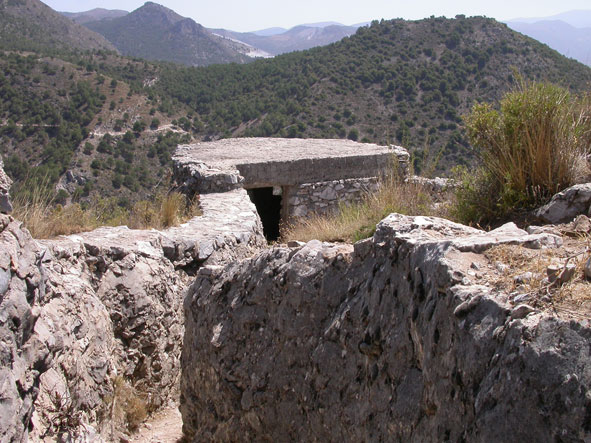
Our son Alan is visiting at the moment, so we decided that it would be good to do a short walk to the Civil War trenches. The trail passes through some beautiful countryside with some stunning views. The trenches have been restored / rebuilt and make for an interesting visit once you have been to the very well located and run visitor's center.
The walk is a gentle upward amble through pine woodlands to the summit of the hill. On the way several Cardinal Fritillaries (Argynnis pandora), Striped Graylings (Pseudotergumia fidia), Dusky Heath (Coenonympha dorus), Cardinal Fritillary (Argynnis pandora) and Scarce Swallowtail (Iphiclides podalirius feisthameli) were seen along with several other species.
The restored trenches.
The centre can be found by taking the signed road / track from the highest point in the delightful village of Viznar just off the A92 to the east of Granada heading for Almeria. 
Alan.
Both Blue Emperor (Anax imperator) and Desert Darter (Sympetrum sinaiticum tarraconesis) were seen at the summit around the defenses.
Dusky Heath (Coenonympha dorus).
Birds were few and far between but European Bee-eaters (Abejaruco Común / Merops apiaster) were passing over heading back south in good numbers. Later we called at a cracking little place on the way back down to Viznar were we had lunch, the Chorizo's were something special.

Monday, 10 August 2009

Rio Guadalahorce, Malaga Province.

Wrong time of the year and worst time of the day.

Little Egret (Garceta Común / Egretta garzetta).
So I was not expecting to see very much and I got what I expected. It was just too hot at 14:30 to be tramping around the reserve but we were meeting our son from the airport at Malaga and it seemed like a good idea. On the first lake a couple of hundred Black-headed Gulls (Gaviota Reidora / Lanus ridibundus) were roosting, a single Black-necked Grebe (Zampullín Cuellinegro / Podiceps nigricollis) and a few White-headed Ducks (Malvasia Cabeciblanca / Oxyura leucocephala) swam and fed amongst them. 
Little Egret (Garceta Común / Egretta garzetta) and Black-winged Stilt (Ciguenuela Común / Himantopus himantopus) were also seen. From the next hide over looking the long pool Common Pochard (Porrón Común / Aythya ferina), Eurasian Coot (Focha Común / Fulica atra), Common Moorhen (Gallineta Común / Gallinula Chloropus), Water Rail (Rascón Europeo / Rallus aquaticus) and Cetti's Warbler (Ruisenor Bastardo / Cettia cetti) were seen and heard.
Woodchat Shrike (Alcaudón Común / Lanius senator).
A single Imm Woodchat Shrike (Alcaudón Común / Lanius senator) was perched on a tall Fennel Stalk and several Monk Parakeets (Cotorra Argentina / Myiopsitta monachus) flew over calling loudly. After a brief visit I was glad to get back to the car.

Sunday, 9 August 2009

Near Huétor Tajar, Granada Province, Spain.

Moth Records for the 8th August 2009.
15W Actinic on the terrace.
Any corrections, PLEASE send me a comment on the post, thanks.

9088 Chrysodeixis chalcites (Golden Twin-spot).
Again the 125 MV trap was used and as the weather was good the catch was reasonable too. 9142 Eublemma parva (Small Marbled) was again the commonest moth trapped, with about 30 caught.
8509 Eupithecia centaureata (Lime-speck Pug).
Emerald Species 7984 Phaiogramma etruscaria x2, a single 9056 Autographa gamma (Silver Y) x1 and 9088 Chrysodeixis chalcites (Golden Twin-spot) x3 were in and around the trap as well. 9460 Spodoptera exigua (Small Mottled Willow) x5, 8211 Vestal (Rhodometra sacraria) x7, 8509 Eupithecia centaureata (Lime-speck Pug) and 6702 Dolicharthria bruguieralis made up some of the rest of the catch.
9056 Autographa gamma (Silver Y).

Saturday, 1 August 2009

RAM and Charca de Suárez, Motril, Granada Province.

Another new bird for my Province list.

Female Red-crested Pochards (Pato Colorado / Netta rufina).

Alice, Juan and I met at the usual junction on the Autovia down towards Motril and headed to cabo Sacratif east of the town. 
The usual birds were seen on the Ram part of the morning, including Balearic (Pardela Balear / Puffinus mauretanicus) and Cory's Shearwater (Pardela Cenicienta / Calonectris diomedea), Northern Gannets (Alcatraz Atlántico / Morus bassanus), Audouin's (Gaviota de Audouin / Larus audouinii), Mediterranean (Gaviota Cabecinegra / Larus melanocephalus) and Yellow-legged Gulls (Gaviota Patiamarilla / Larus Michahellis) and Sandwich Tern (Charrán Patinegro / Sterna sandvicensis) were all recorded on this flat calm morning.
Little Grebe (Zapullín Común / Tachybaptus ruficollis).
During the sea watch, 3 Peregrine Falcons (Halcón Peregrino / Falco peregrinus) were seen to take a Eurasian Hoopoe (Abubilla / Upupa epops) out over the sea, the adult making the kill and passing it to one of the younger birds.
We later popped quickly in at the port where large numbers (200+) Audouin's Gulls were roosting on the dock areas along with Black-headed (Gaviota Reidora / Lanus ridibundus) and Yellow-legged Gulls.
We then made our way to the wetland of Charca de Suárez a little further along the coast, we went into the normal hides but then bumped into one of the wardens, he told us that there was someone in the photographic hide and if we wanted we could go and join him.
Grey Heron (Garza Real / Ardea cinerea).
The light is much better from this hide at the time of day we were there so we managed to get some nice shots of the birds. 
The best birds seen were two female Red-crested Pochards (Pato Colorado / Netta rufina) which were a new Granada Province species for me. Mallard (Anade Azulón / Anas platyrhynchos), Common Pochard (Porrón Europeo / Aythya ferina), Little Grebe (Zapullín Común / Tachybaptus ruficollis), Common Coot (Focha Común / Fulica atra) and Common Moorhen (Gallineta Común / Gallinulas chloropus) were all seen out on the water.
Male Long Skimmer (Orthetrum trinacria).
Several Common Kingfishers (Martin Pescador / Alcedo atthis) and Little Bitterns (Avetorillo Común / Ixobrychus minutus), Grey Heron (Garza Real / Ardea cinerea) were seen around the main lagoon along with Western Swamp-hen (Calamón Común / Porphyrio porphyrio).
A single Black Kite (Milano Negro / Milvus migrans) made several passes over the main lake, causing mayhem for a while. Black Percher (Diplacodes lefebvrii), Common Emperor (Anax imperator), Violet Dropwing (Trithemis annulata), Broad Scarlet (Crocothemis erythraea), Iberian Bluetail (Ischnura graellsii), Black-tailed Skimmer (Orthetrum cancellatum) and a male Long Skimmer (Orthetrum trinacria), this is only the second sighting of this species that I have had in Spain.

Thursday, 30 July 2009

Near Huétor Tajar, Granada Province, Spain.

Moth Records for the 29th July 2009.
15W Actinic on the terrace.
5 Moths of 3 Species.
Any corrections, PLEASE send me a comment on the post, thanks.

7984 Chlorissa etruscaria.
The second night's trapping was carried out with the 125 MV lamp, a much brighter light which attracted in some nice species and a lot of not so nice bitting chaps.
6619 Uresiphita gilvata.
Again 9142 Eublemma parva (Small Marbled) x32 was the commonest species, along with 7725 Menophora japygiaria (Brassy Waved Umber) x8 and 8211 Rhodometra sacaria (The Vestal) x13. 
6704 Antigastra catalaunalis.
A single Emerald Species 7984 Chlorissa etruscaria x1 and 8904 Dysgonia algira (Passenger) x2 were both found on the vegetation around the light.  
6619 Uresiphita gilvata, 8965 Tyta luctuosa (Four-spotted Moth), 9367 Heliothis peltigera (Bordered Straw), Cresent Dart (Agrotis trux), 6690a Palpita vitrealis3036 Stibaromacha ratella and 6704 Antigastra catalaunalis were also seen.
8965 Tyta luctuosa (Four-spotted Moth).

Sunday, 26 July 2009

Parque Nacional de Sierra Nevada, Granada Province.

In search of endemic Wildflowers and Alpine Accentors.

Alpine Accentor (Acentor Alpino / Prunella modularis).

Beatriz, Juan and I set off up to the upper car parks above the ski resort at Sierra Nevada to catch the mini bus which takes you to a point a few hundred meters below the Veleta summit and almost as soon as we got off the bus we picked up the first of about 30+ Alpine Accentor's (Acentor Alpino / Prunella modularis) seen during the day.
Linaria glacialis.
Most were feeding around the areas of snow which still just hang on in the heat of July, something which has not happened for a few years.
On a rocky ledge the first plants were seen and these included Arabis alpina, Polystichum lonchitis, Blue Dream's (Chaenorrhinum glareosum), Arenaria imbricata and Jasion crispa amethystina.
We then moved on upwards slowly picking up Northern Wheatear (Collalba Gris / Oenanthe oenanthe), Eurasian Crag Martin (Avión Roquero / Ptyonoprogne rupestris) and Northern Raven (Cuervo / Corvus corax) on the way.
More Alpine Accentor's were seen near the refuge above Laguna de Aguas Verdes, several Spanish Ibex (Cabra montés / Capra pyrenaica) were feeding around the Lagoon.
We then started the walk out to Laguna de Rio Seco where we were to have our lunch but that was some way off.
Just as we started down the first and pretty much the only slope on this walk we started to find new plants including Mediterranean Kidney Vetch (Anthyllis vulneraria), House Leek (Sempervivum vicentei ssp lainzii), Ranunculus acetosellifolius, Potentilla nevadensis, Reseda complicata and Sierra Nevada Violet (Viola crassiuscula).
Artemisia granatensis.
High on the cliffs Centranthus nevadensis was seen, unfortunately this was the only plant we saw and it was impossible to get within range with the camera. Linaria glacialis, Epilobium alsinifolium, Lotus glareosus and Silene rupestris were all added to the list along the scree slopes as we headed towards the Laguna.
Lunch was taken beside the Laguna and then a search was made by Juan of the steep scree slopes whilst I spent some time checking out the rocky and damp areas around the water. Ranunculus demissus and acetosellifolius were in the damper flushes, along with carpets of Plantago nivalis.
On the drier areas Galium pyrenaicum, Arenaria pungens, Armeria splendens subsp splendens, Sideritis glacialis and Coincya orofila subsp nevadensis were all found.
Juan then called me up to a rock mass amongst some very unstable scree which I eventually crossed and was rewarded with several plants of the very rare Artemisia granatensis, a plant which has become rare mainly through over collecting in the past.
The climbing on the scree had just about finished my ankles, so instead of going back down I headed up to the path and started to walk ahead whilst Juan went down for Beatriz.
Ranunculus acetosellifolius.
They eventually caught me up after a short rain shower had forced me to shelter behind some rocks. We continued the return journey picking up Sedum anglicum subsp melanantherum, Ptilotrichum spinosum and Eryngiun glaciale.
Plantago nivalis.
Blue Dream's (Chaenorrhinum glareosum).

Saturday, 25 July 2009

A Visit to El Museo del Vidrio y Cristal de Malaga, Malaga Province.

A day in the City of Malaga.

Main Entrance.
Jayne and I have lived near Granada for about four years now and had not visited the centre of Malaga, but with an invite from Ian Phillips to go and have a preview visit to the Museum it was to good an opportunity to miss. 
Some of the windows.
We arrived and had a coffee in the plaza at the western end of the Cathedral and meet Ian at eleven o'clock as arranged. We then made our way through the city to the Museum and Ian's home which was in a narrow street only a few hundred meters from the main plaza.
The outside of the building had been restored back to it former glory and looked fantastic. The inside had also been fully restored with beautiful wooden doors and windows and amazing stone and terracotta floors. The entrance hall and lower rooms had some very impressive stained glass windows, nicely mounted on the walls.
Some Blue and White.
On the next floor there was a fine show of Antique furniture, much of which was filled with some very special glass and china. On the walls hung a collection of oil paintings, many of which belong to one of the partners in the project and portrayed some of his ancestors. Later we sat in one of the upstairs rooms and chatted for some time and enjoyed a glass of wine whilst watching the end of a wedding taking place in the church opposite.
Ian.
Lunch was the next stop in a very nice restaurant which Ian knew well. We then made our way back through the streets, said our goodbyes to Ian. On our way back to the car we saw both Monk (Cotorra Argentina / Myiopsitta monachus) and Ring-necked Parakeets (Cotorra de Kramer / Psittacula krameri) on the sea front walk.

Museum Contact details: Address -Plazuela Santisimo Cristo de la Sangre 2, (Antigua Calle Gaona 20), 29012 Malaga. Web Page- http://www.museovidrioycristalmalaga.com/