We set off from home and drove down to the sea front at Torremolinos where we were going to spend the day on the beach getting some sun. So when we arrived to a grey overcast sky we were unsure what to do but eventually we just went and got some sunbeds and braved it. It certainly was not cold and a distant crack of blue in the grey gave us some hope. I had a very nice dip in the see which was not as cold as I thought it might be and then we went and had some lunch in the bar behind us. As we were eating the sun came out and that was the way it stayed until we venchered off the beach at about 18:30 for the trip home. I did take the bins but its hard birding with so many people half dressed on the beach but I did see Balearic (Pardela Balear / Puffinus mauretanicus) and Cory's Shearwaters (Pardela Cenicienta / Calonectris diomedea), Northern Gannet (Alcatraz Atlántico / Morus bassanus), Sandwich Tern (Charrán Patinegro / Sterna sandvicensis), Yellow-legged (Gaviota Patiamarilla / Larus Michahellis), Lesser Black-backed (Gaviota Somria / Larus fuscus), Mediterranean (Gaviota Cabecinegra / Larus melanocephalus), Black-headed (Gaviota Riedora / Larus ridibundus) and Audouin's Gulls (Gaviota de Audouin / Larus audouinii). While we were lying the I also noticed a good passage of House Martins (Avión Común / Delichon urbica), Barn (Golondrina Común / Hirundo rustica) and Red-rumped Swallows (Golondrina Dáurica / Hirundo daurica) heading west along the coast.
Friday, 21 September 2012

Thursday, 20 September 2012
Guadalhorce, Malaga Province and Near Huétor Tajar, Granada Province, Spain.
A Morning with the Axarquia Bird Group.
 |
| Eurasian Oystercatcher (Ostrero Euroasiatico / Haematopus ostralegus). |
 |
| Monk Parakeet (Cotorra Argentina / Myiopsitta monachus). |
 |
| Mediterranean Gull (Gaviota Cabecinegra / Larus melanocephalus). |
 |
| Common Kestrel (Cernicalo Vulga / Falco tinnunculus). |
At just after 09:30 20 more birders arrived for the walk around the reserve including Bob Wright, Andy Paterson and Steve and Elena Powell just to name a few, after the customary chinwag we set off and made our way over the bridge and out towards the first of the hides which over looks the reed fringed pool on the track out to the far sea watch hide. Straight away we started to see new species including 3 Gadwall (Anade Friso / Anas strepera) and a Little Grebe (Zampullín Común / Tachybaptus ruficollis) on the river, a female Marsh Harrier (Aguilucho Lagunero Occidental / Circus aeruginosus) over the main lake and just before the hide we had the first of half a dozen Honey Buzzards (Aberjero Europeo / Pernisapivorus) pass over head. From the hide we saw Mallard (Anade Azulón / Anas platyrhynchos), Common Pochard (Porrón Europeo / Aythya ferina), Eurasian Teal (Cerceta Común / Anas crecca) before moving on to the wader hide where we added a single Black-winged Stilt (Ciguenuela Común / Himantopus himantopus) and a Reed Warbler (Carricero Común / Acrocephalus scirpaceus) to the list.
 |
| Western Osprey (Águila Pescardora / Pandion haliaetus). |
Next we had a look from the sea watch point but the sea had now gone flat calm and we only managed to locate a few gulls all of which I had seen earlier, the Eurasian Oystercatcher did a fly-by and the only Greater Flamingo (Flamenco Común / Phoenicopterus ruber) of the day flew up the river. We then made our way along the beach towards the track back onto the
reserve, during the track through the sand we added a single Short-toed Lark (Terrera Común / Calandrella brachydactyla), House Martin (Avión Común / Delichon urbica) and a couple more Sanderlings. Once back on harder ground we made our way to the main hide where we quickly busted the list with Green Sandpiper (Andarrios Grande / Tringa ochropus), Spoonbill (Espátula Común / Platalea leucorodia), Common Redshank (Archibebe Común / Tringa totanus), Little Ringed Plover (Chorlitejo Chico / Charadrius dubius), Snipe (Agachadiza Común / Gallinago gallinago), Sand Martin (Avión Zapador / Riparia riparia) and just as we were leaving 3 Glossy Ibis (Morito Común / Plegadis falcinellus) flew around but did not land.
We moved onto the last hide over the narrow pool where I eventually caught up with White-headed Duck (Malvasia Cabeciblanca / Oxyura leucocephala) and picked up a single Spanish (Yellow) Wagtail (Lavandera Boyera / Motacilla flava iberiae) which flew up from the margins. After a while Bob and the birders that were left decided to walk back to the car, I went back via the beach and had another quick look at the main hide on the way but only added a second Osprey to my list before heading back to the car and driving home.
 |
| White-headed Duck (Malvasia Cabeciblanca / Oxyura leucocephala). |
I spent the rest of the afternoon on the terrace with Jayne and Barb, while I was there I saw several new species for my day list including Common Chaffinch (Pinzón Vulgar / Fringilla coelebs), Iberian Magpie (Rabilargo / Cyanopica cooki), Blackbird (Mirlo Común / Turdus merula), an adult Golden Eagle (Águila Real / Aquila chrysaetos), 3x Sparrowhawks (Gavilán Común / Accipiter nisus), a good number of passing Alpine Swift (Vencejo Real / Apus melba) along with several late Commons (Vencejo Común / Apus apus), Woodpigeon (Paloma Torcaz / Columba palumbus) and a scattering of Crag Martins (Avión Roquero / Ptyonoprogne rupestris) amongst the flocks of other hirundines.
I finished the day off on 82 species.
Wednesday, 19 September 2012
Medina Azahara and Codoba City, Cordoba Province.
A day out with Jayne's sister.
 |
| Aljama Mosque. |
 |
| Cooking Oven. |
Blue Rock Thrush (Roquero Solitario / Monticola solitarius), Common Crossbill (Piquituerto Común / Loxia curvirostra), singing Corn Buntings (Triguero / Emberiza calandra), Hoopoe (Abubilla / Upupa epops), Pied Flycatcher (Papamoscas Cerrojillo / Ficedula hypoleuca), Firecrest (Reyezuelo Listado / Regulus ignicapillus), Iberian Grey Shrike (Alcaudón Real Meridional /Lanius meridionalis) and Short-toed Treecreeper (Agateador Común / Certhia brachydactyla).
Later we caught the bus back to the carpark and headed into the city and parked in a free spot near the river. We were by this time quite hungry so we stopped and had lunch before walking along the river and crossing into the city via the reformed Roman bridge, on the walk I saw Little Egret (Garceta Común / Egretta garzetta), Grey Heron (Garza Real / Ardea cinerea), Grey Wagtail (Lavandera Cascadena / Motacilla cinerea), Lesser Kestrel (Cernicola Primilla / Falco naumanni), Common Sandpiper Andarrios Chico / Actitis hypoleucos) and Crag Martin (Avión Roquero / Ptyonoprogne rupestris).
We spent a pleasant couple of hours around the back streets of the historic section, had a very nice ice-cream before wandering back to the car and heading home, on the way adding a few Common Buzzards (Busardo Ratonero / Buteo buteo).
 |
| Jayne and Barb. |
 |
| Courtyard of the Pillars. |
 |
| Arch ar the far end of the Cordoba Roman Bridge. |
 |
| The Roman Bridge. |
Tuesday, 18 September 2012
Home near Huétor Tajar, Granada Province, Spain.
A bit more Migration over and through the Fig tree.
The day started off OK, Jayne and Barb headed down into Huetor to have a look at the market and do some food shopping whilst I waited at home for a Log delivery ready for the winter. By 12:00 there was no sign of the Logs so I gave the chap a ring and in my broken Spanish asked why he had not delivered the load, I understood that he was eating and would get to us asap , but not the load I was expecting as this was the wrong log man but I did not know this at the time. So just as Jayne and Barb got back the load of logs arrived and I carried them in and stacked them. We then had some lunch and while we were sat up on the terrace in what can only be described as overcast conditions I started to pick up a few Short-toed Eagles (Culebrera Europeo / Circaetus gallicus) which due to the conditions were coming through quite low. These were followed by two Booted Eagles (Aguila Calzada / Aquila pennatus) one of each colour morph and shortly afterwards a duo of Black Kites (Milano Negro / Milvus migrans). Short-toed Eagles continued to come through and by the end of the couple of hours of scanning the skies 14 had passed over along with another 26 Black Kites which came through in one flock and a single Sparrowhawk (Gavilán Común / Accipiter nisus).
At lower levels a couple of Pied Flycatchers (Papamoscas Cerrojillo / Ficedula hypoleuca) stopped off to spend some time feeding up and a single Subalpine Warbler (Curruca Carrasquena / Sylvia cantillans) was also seen briefly down in the barranco. Up to this point the day had gone well but then the bell rang and I went and met another Spanish chap with an even bigger load of logs on a trailer, I asked him what he wanted and he replied that you rang earlier and asked for a log delivery, I said that I had not but he showed me my number at the time I thought I was talking to the first log guy. Anyway to cut a long story short we ended up unloading another great big load of logs, this time Jayne and Barb gave me a hand (Sorry) and we had it done in just over an hour. We have now got enough wood to last us until the new year but the yard does look a little full! This will teach me to check that I am ringing the right chap the next time!!!!!
 |
| Pale morph Booted Eagle (Aguila Calzada / Aquila pennatus). |
 |
| Pied Flycatcher (Papamoscas Cerrojillo / Ficedula hypoleuca). |
Monday, 17 September 2012
Home near Huétor Tajar, Granada Province, Spain.
A bit of Migration over the Fig tree.
Jayne and I set off down to Malaga Airport to pick up her sister who was coming over for a 10 day break. We met Barb and then came straight back up to the house as she had been up since 03:00 and just fancied a quiet afternoon on the terrace. We arrived back at about 12:30 and sorted out some drinks and a snake and went up on the back and spent the rest of the day there relaxing and watching the world (and a few birds) go by. The local residents were all knocking around in the garden including Iberian Magpie (Rabilargo / Cyanopica cooki), Sardinian Warbler (Curruca Cabecinegra / Sylvia melanocephala), House Sparrow (Gorrión Común / Passer Domesticus), Blackbird (Mirlo Común / Turdus merula) and Great Tit (Carbonero Común / Parus major). Greenfinch (Verderón Común / Carduelis chloris), Goldfinch (Jilguero / Carduelis carduelis), Linnet (Pardillo Común / Carduelis cannabina), Serin (Verdecillo / Serinus serinus), Red-rumped (Golondrina Dáurica / Hirundo daurica) and Barn Swallows (Golondrina Común / Hirundo rustica) and House Martins (Avión Común / Delichon urbica) were all seen flying over the olives.
During the afternoon several Raptors were recorded including three different Golden Eagles (Águila Real / Aquila chrysaetos), two immature birds (one with a couple of primaries missing) and a very smart looking adult. Other species seen were Common Buzzard (Busardo Ratonero / Buteo buteo) x2, Black Kite (Milano Negro / Milvus migrans) x1, Short-toed Eagle (Culebrera Europeo / Circaetus gallicus) x2 and a single Sparrowhawk (Gavilán Común / Accipiter nisus) which was mobbing one of the immature Golden Eagles. Whilst we were sat there I also saw a couple of male Orange-winged Dropwing (Trithemis kirbyi), a female Epaulet Skimmer (Orthetrum chrysostigma), Speckled Wood (Pararge aegeria), Geranium Bronze (Cacyreus marshalli), Small White (Artogeia rapae) and a Large Tortoiseshell (Nymphalis polychloros).
During the afternoon several Raptors were recorded including three different Golden Eagles (Águila Real / Aquila chrysaetos), two immature birds (one with a couple of primaries missing) and a very smart looking adult. Other species seen were Common Buzzard (Busardo Ratonero / Buteo buteo) x2, Black Kite (Milano Negro / Milvus migrans) x1, Short-toed Eagle (Culebrera Europeo / Circaetus gallicus) x2 and a single Sparrowhawk (Gavilán Común / Accipiter nisus) which was mobbing one of the immature Golden Eagles. Whilst we were sat there I also saw a couple of male Orange-winged Dropwing (Trithemis kirbyi), a female Epaulet Skimmer (Orthetrum chrysostigma), Speckled Wood (Pararge aegeria), Geranium Bronze (Cacyreus marshalli), Small White (Artogeia rapae) and a Large Tortoiseshell (Nymphalis polychloros).
Later we had a nice meal sat out and just as it was going dark two Red-necked Nightjars (Chotacabras Cuellirrojo / Caprimulgus ruficollis) did quite close fly-bys.
Friday, 14 September 2012
Travelling to and at Rio Velez, Malaga Province.
Lots of visible bird migration.
Jayne and I set off down to Torre del Mar on the cross country route via Salar and Venta de Zafarraya on the way we saw several Lesser Kestrels (Cernicola Primilla / Falco naumanni) which were still in the usual spots along the way along with Iberian Magpie (Rabilargo / Cyanopica cooki), Black Kite (Milano Negro / Milvus migrans), Calandra (Calandria / Melanocorypha calandra), Crested (Cogujada Común / Galerida cristata) and Thekla Larks (Cogujada Montesina / Galerida theklae), Sparrowhawk (Gavilán Común / Accipiter nisus), Iberian Grey Shrike (Alcaudón Real Meridional / Lanius meridionalis), Rock Sparrow (Gorrión Chillón / Petronia petronia), Hoopoe (Abubilla / Upupa epops), Red-legged Partridge (Perdiz Roja / Alectoris rufa), Corn Bunting (Triguero / Emberiza calandra) and Common Buzzard (Busardo Ratonero / Buteo buteo).
I dropped Jayne off in Torre and went down to the Rio Velez for a couple of hours birding, straight away I stared to see interesting species including Green (Andarrios Grande / Tringa ochropus) and Common Sandpipers (Andarrios Chico / Actitis hypoleucos), Little Ringed Plover (Chorlitejo Chico / Charadrius dubius) and Melodious Warbler (Zarcero Común / Hippolais polyglotta). I then walked down stream towards the beach for a while adding Reed (Carricero Común / Acrocephalus scirpaceus), Great Reed (Carricero Tordal / Acrocephalus arundinaceus), Sardinian (Curruca Cabecinegra / Sylvia melanocephala) and Cetti’s Warblers (Ruisenor Bastardo / Cettia cetti), Nightingale (Ruisenor Común / Luscinia megarhynchos) and Robin (Petirrrojo / Erithacus rubecula).
I then went back up on to the track and walked down as far as the pump house and then started to have a look across the fields from some of the many tracks. Here migration was quite obvious with large numbers of Red-rumped (Golondrina Dáurica / Hirundo daurica) and Barn Swallows (Golondrina Común / Hirundo rustica) moving west through the site along with a lot of House (Avión Común / Delichon urbica) and just a sprinkling of Sand Martins (Avión Zapador / Riparia riparia). There were a couple of fields which had been left fallow for some time and were now covered in quite a dense growth of weeds / wildflowers and amongst them I located a couple of Dartford Warblers (Curruca Rabilarga / Sylvia undata), a single Common Whitethroat (Curruca Zarcera / Sylvia communis), several Willow Warblers (Mosquitero Musical / Phylloscopus trochillus), a single male Subalpine (Curruca Carrasquena / Sylvia cantillans) and in one of the fruit trees the first of at least 3 Orphean’s (Curruca Mirlona / Sylvia hortensis).
Also seen out in the more open areas was a single male Black-eared (Collalba Rubia / Oenanthe hispanica) and 4x Northern Wheatears (Collalba Gris / Oenanthe oenanthe), a flock of 9 Skylarks (Alondra Común / Alauda arvensis), the more usual Thekla and Crested, 5x Common Waxbills (Estrilda Ondulada / Estrilda astrild) and Zitting Cisticola (Buitrón / Cisticola juncidis).
I then made my way out onto the beach and immediately found 3 Sanderlings (Correlimos Tridáctilo / Calidris alba) running with the waves. I then set the scope up and scanned through the birds out to see and quickly counted over 90 Cory's Shearwaters (Pardela Cenicienta / Calonectris diomedea) most of them sat on the sea in a couple of rafts, a couple of Balearic’s (Pardela Balear / Puffinus mauretanicus) flew through heading east along with quite a few Northern Gannets (Alcatraz Atlántico / Morus bassanus) and Sandwich Terns (Charrán Patinegro / Sterna sandvicensis).
After a few minutes a lot of the Shearwaters and the loafing Gulls flew and gathered around an area of what looked like newly discharge sewage just off the coast which gave me chance to get some nice views, while I was scanning through the flock I was surprised to pick up a Sparrowhawk in amongst the scrum. Gulls included Black-headed (Gaviota Riedora / Larus ridibundus), Audouin's (Gaviota de Audouin / Larus audouinii), Mediterranean (Gaviota Cabecinegra / Larus melanocephalus), Lesser Black-backed (Gaviota Somria / Larus fuscus) and of course Yellow-legged (Gaviota Patiamarilla / Larus Michahellis). I then ad a look at the beach pool but apart from a few Lesser (Anax parthenope) and Blue / Common Emperors (Anax imperator) it was empty, not even a Eurasian Coot (Focha Común / Fulica atra).
I then made my way slowly back along the Rio looking for more Dragons as I went adding Black Percher (Diplacodes lefebvrii), Broad Scarlet (Crocothemis erythraea), Iberian Bluetail (Ischnura graellsii), Epaulet Skimmer (Orthetrum chrysostigma), Red-veined Darter (Sympetrum fonscolombii) and a single male Migrant Hawker (Aeshna mixta). New bird species included Turtle Dove (Tórtola Europea / Streptopelia turtur), Spanish (Yellow) (Lavandera Boyera / Motacilla flava iberiae), White (Lavandera Blanca / Montacilla alba) and Grey Wagtails (Lavandera Cascadena / Motacilla cinerea), a small flock of Tree Sparrows (Gorrión Molinero / Passer Montanus), 2x Squacco’s (Garcilla Cangrejera / Ardeola ralloides) and a single Grey Heron (Garza Real / Ardea cinerea), two Garden Warblers (Curruca Mosquitera / Sylvia borin) which were a bit of a surprise, Western Cattle (Garcilla Bueyera / Bubulcus ibis) and Little Egrets (Garceta Común / Egretta garzetta), 3x Kingfishers (Martin Pescador / Alcedo atthis), Monk Parakeet (Cotorra Argentina / Myiopsitta monachus), Pied (Papamoscas Cerrojillo / Ficedula hypoleuca) and Spotted Flycatchers (Papamoscas Gris / Muscicapa striata) and just as I was getting back to the car a single Honey Buzzard (Aberjero Europeo / Pernis apivorus) which was making its way west.
A total of 81 species of birds were seen during the trip there and back and at the Rio, a very pleasing total.
 |
| Green Sandpiper (Andarrios Grande / Tringa ochropus). |
 |
| Sanderling (Correlimos Tridáctilo / Calidris alba). |
 |
| Sanderling (Correlimos Tridáctilo / Calidris alba). |
 |
| Immature Spotless Starling (Estornino Negro / Sturnus unicolor). |
I then made my way out onto the beach and immediately found 3 Sanderlings (Correlimos Tridáctilo / Calidris alba) running with the waves. I then set the scope up and scanned through the birds out to see and quickly counted over 90 Cory's Shearwaters (Pardela Cenicienta / Calonectris diomedea) most of them sat on the sea in a couple of rafts, a couple of Balearic’s (Pardela Balear / Puffinus mauretanicus) flew through heading east along with quite a few Northern Gannets (Alcatraz Atlántico / Morus bassanus) and Sandwich Terns (Charrán Patinegro / Sterna sandvicensis).
 |
| Tree Sparrow (Gorrión Molinero / Passer Montanus). |
 |
| Monk Parakeet (Cotorra Argentina / Myiopsitta monachus). |
A total of 81 species of birds were seen during the trip there and back and at the Rio, a very pleasing total.
Monday, 10 September 2012
Marbella and Coin area, Malaga Province.
Checking the aftermath of the Malaga / Marbella Fires.
 |
| Some distant burnt of woods. |
 |
| Some more burnt off areas. |
Sunday, 9 September 2012
Huétor Tájar, Granada Province.
Zoco, Andalusí
Jayne and I went down to the Zoco as we have done for the past 6 years and again we really enjoyed the fantastic atmosphere as the Spanish families were having a great time. We particularly enjoyed the Medieval dancing which was performed by around 40 people in the afternoon heat and was well worth watching.
I also had an interesting talk with the falconer who had bought a couple of Harris and a Red-tailed Hawk along but these were easily out shone by the beautiful 15 year old female Eagle Owl.
We had a couple of drinks in the local bars around the Plaza de Andalucía and spent a very enjoyable 4 hours at this local event.
 |
| The Event poster. |
 |
| Eagle Owl (Buho Real / Bubo bubo). |
 |
| Bread stall. |
 |
| Crate climbing. |
 |
| Kids on the Dragon Swing. |
Saturday, 8 September 2012
Loja, Granada Province.
The September GOOD FORK CLUB meeting.
After a very good days birding it was great to finish off with a brilliant evening / night with friends down in Loja at Jean and Davids house. We arrived at 19:30 to find the table set in the very nice surroundings of the court yard and ready for our next GOOD FORK meal.
David and Jean were there to met us and Dennis and Sue were hard at work getting the final parts of the meal ready. Soon Em and Greg, Peter and Silvia and Cherry had arrived and we all settled down to a cracking meal.
We also enjoyed some good wine and by the end of the night some very interesting (sometimes lively) conversation!! Thanks again to Dennis, Sue, Jean and David for all their work and for another enjoyable evening.
 |
| Den and Jayne. |
 |
| Em and Greg. |
 |
| David and Peter. |
 |
| Cherry, Jean and Sylvia. |
 |
| The food. |
Charca del Suarez, Granada Province.
An interest morning for the birds and Dragons.
I met up with Beatriz and Juan at the usual spot in Granada but at a much better time of the morning than usual 08:00 and we headed down to the coast to spend a morning birding at and around Charca del Suarez.
 |
| Black-winged Kite (Elanio Común / Elanus caeruleus). |
We were meeting Jacinto at the reserve at 09:00 so as we were a little early we had a look at the damp areas behind the industrial units just off the road down to the port.
We pulled up once we were on the side road to get the bins out and had a scan over the nearby fields, Beatriz soon found several European Serin (Verdecillo / Serinus serinus) which were coming down to feed on the road side along with at least 3 Red Avadavats (Bengali Rojo / Amandava amandava).
I then picked up a small raptor in a small tree out in the cane fields which I immediately identified as a Black-winged Kite (Elanio Común / Elanus caeruleus) and quickly got Juan and Beatriz on to it, but the bird was still sat in the same spot as we drove off heading towards the reserve entrance.
 |
| Cetti’s Warbler (Ruisenor Bastardo / Cettia cetti). |
On the way we also saw Barn Swallow (Golondrina Común / Hirundo rustica), Common Blackbird (Mirlo Común / Turdus merula), Eurasian Turtle Dove (Tórtola Europea / Streptopelia turtur), White Wagtail (Lavandera Blanca / Montacilla alba) and Western Cattle Egret (Garcilla Bueyera / Bubulcus ibis). We arrived to find the gates were already open and Jacinto waiting for us so we went in and had a chat with Manuel Mañani the warden and another chap who was doing some ringing.
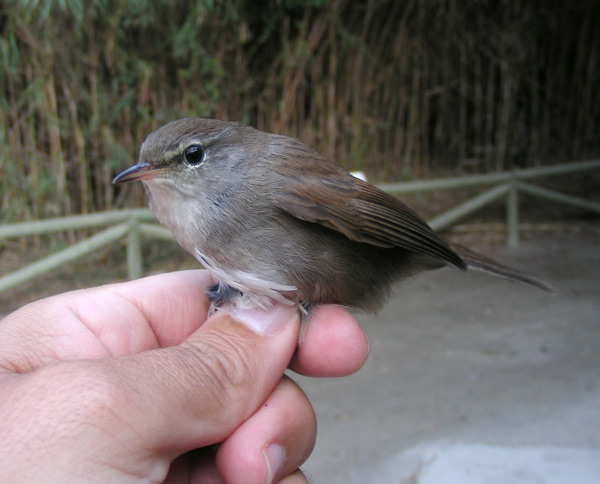
He was just processing some birds including a couple of Common Reed Warblers (Carricero Común / Acrocephalus scirpaceus), Cetti’s Warbler (Ruisenor Bastardo / Cettia cetti) and a Common Nightingale (Ruisenor Común / Luscinia megarhynchos).
 |
| Common Nightingale (Ruisenor Común / Luscinia megarhynchos). |
At this point Juan, Jacinto and another birder who was watching the ringing walked back to the spot where we had earlier seen the Kite while Beatriz and I stayed and did a trap round with the ringer.
We started by heading down the edge of the site where he had placed half a dozen spring type traps which were baited with a meal worn, not sure how legal they would be, all but one were empty and this had a nice Eurasian Robin (Petirrrojo / Erithacus rubecula) in it.
 |
| European Robin (Petirrrojo / Erithacus rubecula). |
We returned and the European Robin was processed and then we walked out to the back of Laguna del Taraje and checked the long row of 60ft mist nets, here we found another couple of Common Reed Warbler and a single Willow Warbler (Mosquitero Musical / Phylloscopus trochillus).
Returned to the hut where the birds were processed, a little later Juan and the others returned and had seen the Kite which was still sat in the same tree.
We then made our way around the reserve starting at Laguna del Lirio where we added Little Grebe (Zampullín Común / Tachybaptus ruficollis), Mallard (Anade Azulón / Anas platyrhynchos), Eurasian Coot (Focha Común / Fulica atra), Common Moorhen (Gallineta Común / Gallinula Chloropus) and Common Kingfisher (Martin Pescador / Alcedo atthis) to the list along with Lesser Emperor (Anax parthenope), Small Red-eyed (Erythromma viridulum) and Broad Scarlet (Crocothemis erythraea).
We moved on around to the first hide which overlooks Laguna del Trébol but this was fairly quiet and we only managed to add a calling Water Rail (Rascón Europeo / Rallus aquaticus), four Eurasian Teal (Cerceta Común / Anas crecca) which flew over and dropped in on the far pool, Common Kestrel (Cernicalo Vulga / Falco tinnunculus), European Goldfinch (Jilguero / Carduelis carduelis) and Great Reed Warbler (Carricero Tordal / Acrocephalus arundinaceus).
At the second hide overlooking the pool we picked up Western House Martin (Avión Común / Delichon urbica), Eurasian Hoopoe (Abubilla / Upupa epops), Little Egret (Garceta Común / Egretta garzetta), Red Avadavat males which were carrying feathers to build their nests and Spotted Flycatcher (Papamoscas Gris / Muscicapa striata).
 |
| Not so good looking traps. |
 |
| Willow Warbler (Mosquitero Musical / Phylloscopus trochillus). |
At the second hide overlooking the pool we picked up Western House Martin (Avión Común / Delichon urbica), Eurasian Hoopoe (Abubilla / Upupa epops), Little Egret (Garceta Común / Egretta garzetta), Red Avadavat males which were carrying feathers to build their nests and Spotted Flycatcher (Papamoscas Gris / Muscicapa striata).
We then moved on around to the main hide, but just before we reached there I spotted a small Dragonfly which settled in a tamarisk bush and allowed just the one shot before disappearing.
I had thought when I first saw it that it was a female Black Percher (Diplacodes lefebvrii) but the size and white looking pterostigma’s made me think otherwise.
 |
| Black Percher (Diplacodes lefebvrii). |
When I got home I sent the shot to Steve Jones (Dragonfly expert and Cornish County recorder) and he confirmed that it was in fact a teneral female Black Percher and the pterostigmas would darken with age and the size of this species can be very variable, sometimes due to a shorter larval stage (Thanks Steve).
I then went into the hide where we had some more nice views of a Common Kingfisher, Northern Shoveler (Cuchara Común / Anas clypeata), Common Pochard (Porrón Europeo / Aythya ferina), Black-headed Gull (Gaviota Riedora / Larus ridibundus), Grey Heron (Garza Real / Ardea cinerea), a nice Western Swamp-hen (Calamón Común / Porphyrio porphyrio) which swam right out in the open and showed well, Red-rumped Swallow (Golondrina Dáurica / Hirundo daurica) and a few fly over Yellow-legged Gulls (Gaviota Patiamarilla / Larus Michahellis).
We stayed in here for some time, after about an hour the ringer turned up with a bird bag from which he produced a beautiful Common Kingfisher which he had just ringed.
I then went into the hide where we had some more nice views of a Common Kingfisher, Northern Shoveler (Cuchara Común / Anas clypeata), Common Pochard (Porrón Europeo / Aythya ferina), Black-headed Gull (Gaviota Riedora / Larus ridibundus), Grey Heron (Garza Real / Ardea cinerea), a nice Western Swamp-hen (Calamón Común / Porphyrio porphyrio) which swam right out in the open and showed well, Red-rumped Swallow (Golondrina Dáurica / Hirundo daurica) and a few fly over Yellow-legged Gulls (Gaviota Patiamarilla / Larus Michahellis).
 |
| Kingfisher (Martin Pescador / Alcedo atthis). |
We all took the chance to take some shots of this cracking bird before he released it on to the main lake. As the time drew near to the closing of the reserve we started to make our way back to the exit via the small reed filled Laguna del Taraje and again we had more views of Common Kingfishers along with Black-tailed Skimmer (Orthetrum cancellatum), a fine male Long Skimmer (Orthetrum trinacria) and several Red-veined Darters (Sympetrum fonscolombii). We then moved on back to the gates and Jacinto headed off to Malaga and the three of us went north to Granada.
Friday, 7 September 2012
Huétor Tájar, Granada Province.
A walk around Huétor.
Jayne and I made our way down to the part of the ring road around the town near to where the main road crosses the Genil and started to walk anti-clockwise around the town. The first stretch was along the Genil but the only things seen were the Feral Geese that escaped from the duck pond in the park and have so far refused to return. We continued on along side the park and passed the agricultural stretch where in the quite natural looking irrigation channel there were a couple of Iberian Bluetails (Ischnura graellsii) resting on a species of Pondweed possibly Potamogeton gramineus but I will have to check it some other time. Also seen in this stretch were Red-veined Darter (Sympetrum fonscolombii) and Bath White (Blanqiverdosa / Pontia daplidice).
Birds included Zitting Cisticola (Buitrón / Cisticola juncidis), the Iberian race of Spanish (Yellow) Wagtail (Lavandera Boyera / Motacilla flava iberiae), Turtle Dove (Tórtola Europea / Streptopelia turtur), Serin (Verdecillo / Serinus serinus), Linnet (Pardillo Común / Carduelis cannabina) and Barn Swallow (Golondrina Común / Hirundo rustica). We then went up passed the cemetery and on to the Northern side of the town where we had good views out over my local patch, here we added Western Cattle Egret (Garcilla Bueyera / Bubulcus ibis), Collared Dove (Tórtola Turca / Streptopelia decaocto), Common Kestrel (Cernicalo Vulga / Falco tinnunculus), Common Stonechat (Tarabilla Común / Saxicola torquata), Crested Lark (Cogujada Común / Galerida cristata), Goldfinch (Jilguero / Carduelis carduelis), Grey Heron (Garza Real / Ardea cinerea) and Red-rumped Swallow (Golondrina Dáurica / Hirundo daurica).
The last third of the walk was down the western side of the town past the feria ground which was being prepared ready for next weeks fiesta and down to the river again and back along to the car. Along here we saw a single Little Egret (Garceta Común / Egretta garzetta) and an albino Collared Dove which stood out well in the Tamarisk trees along the river. During the walk a few more plants were seen including Xanthium spinosum, Hoary Mullien (Verbascum pulverulentum), Spanish Thistle (Scolymus hispanicus), Shrub Tobacco (Nicotinana glauca), Squirting Cucumber (Ecballium elaterium), Mediterranean Daphne (Daphne gnidium) and Borage (Borago officinalis).
Birds included Zitting Cisticola (Buitrón / Cisticola juncidis), the Iberian race of Spanish (Yellow) Wagtail (Lavandera Boyera / Motacilla flava iberiae), Turtle Dove (Tórtola Europea / Streptopelia turtur), Serin (Verdecillo / Serinus serinus), Linnet (Pardillo Común / Carduelis cannabina) and Barn Swallow (Golondrina Común / Hirundo rustica). We then went up passed the cemetery and on to the Northern side of the town where we had good views out over my local patch, here we added Western Cattle Egret (Garcilla Bueyera / Bubulcus ibis), Collared Dove (Tórtola Turca / Streptopelia decaocto), Common Kestrel (Cernicalo Vulga / Falco tinnunculus), Common Stonechat (Tarabilla Común / Saxicola torquata), Crested Lark (Cogujada Común / Galerida cristata), Goldfinch (Jilguero / Carduelis carduelis), Grey Heron (Garza Real / Ardea cinerea) and Red-rumped Swallow (Golondrina Dáurica / Hirundo daurica).
The last third of the walk was down the western side of the town past the feria ground which was being prepared ready for next weeks fiesta and down to the river again and back along to the car. Along here we saw a single Little Egret (Garceta Común / Egretta garzetta) and an albino Collared Dove which stood out well in the Tamarisk trees along the river. During the walk a few more plants were seen including Xanthium spinosum, Hoary Mullien (Verbascum pulverulentum), Spanish Thistle (Scolymus hispanicus), Shrub Tobacco (Nicotinana glauca), Squirting Cucumber (Ecballium elaterium), Mediterranean Daphne (Daphne gnidium) and Borage (Borago officinalis).
Thursday, 6 September 2012
Frigiliana, Nerja and Rincon de la Victoria, Malaga Province.
A day on the Costa.
Jayne and I set off reasonable early for the coast after getting an email from a person who was getting me some stationary from the UK to say she had my order. On the way down to Velez Malaga we went along the usual route via Salar, Venta de Zafarraya and down through the English enclave of Cruce de Don Manuel until we reached the coastal motorway.
On the way we saw several interesting species including an immature Montagu's Harrier (Aguilucho Cenizo / Circus pygargus), Lesser Kestrel (Cernicola Primilla / Falco naumanni), Iberian Grey Shrike (Alcaudón Real Meridional / Lanius meridionalis), European Bee-eater (Abejaruco Común / Merops apiaster), Hoopoe (Abubilla / Upupa epops), Iberian Magpie (Rabilargo / Cyanopica cooki), Turtle Dove (Tórtola Europea / Streptopelia turtur), Thekla (Cogujada Montesina / Galerida theklae), Short-toed (Terrera Común / Calandrella brachydactyla), Crested (Cogujada Común / Galerida cristata) and Calandra Larks (Calandria / Melanocorypha calandra).
We drove along the coast and were soon in Frigiliana and had soon found the market but unfortunately Janet had been sent the wrong books when we opened them up so we left bookless but decided to say and have a look around this very nice white town and in some of its shops (mistake). Will I stared it off with a decorative frog for the back terrace and then Jayne joined in by finding a throw for the settee which was in just the colours we wanted, so it was not a wasted journey.
We then continued on to Nejar where we again had a nice walk around, this was followed by a brief visit to the centre at Velez Malaga and then a trundle along the coast road towards Malaga. A while ago a friend Brenda Jones had told us how nice Rincon de la Victoria was so when we reach this area we parked up and had a walk along the prom and she was quite right it was very nice. We headed west and through a large tunnel in the coastal cliffs and then took the cliff top walk down into La Cala del Moral where we had a drink at a nice beach side bar before walking back again, in total it was a nice 3 ½ hours walk.
Like a plank did not take my bins on the walk but I did see Audouin's (Gaviota de Audouin / Larus audouinii), Black-headed (Gaviota Riedora / Larus ridibundus), Lesser Black-backed (Gaviota Somria / Larus fuscus) and Yellow-legged Gulls (Gaviota Patiamarilla / Larus Michahellis), a couple of Cory's Shearwaters (Pardela Cenicienta / Calonectris diomedea) which passed incredibly close into shore and a very green Iberian Wall Lizard (Podarcis hispanica). Once back at the car we made our way home via the motorways, on the journey the only new species was a Short-toed Eagle (Culebrera Europeo / Circaetus gallicus) which was taking a break on an electrical pylon.
On the way we saw several interesting species including an immature Montagu's Harrier (Aguilucho Cenizo / Circus pygargus), Lesser Kestrel (Cernicola Primilla / Falco naumanni), Iberian Grey Shrike (Alcaudón Real Meridional / Lanius meridionalis), European Bee-eater (Abejaruco Común / Merops apiaster), Hoopoe (Abubilla / Upupa epops), Iberian Magpie (Rabilargo / Cyanopica cooki), Turtle Dove (Tórtola Europea / Streptopelia turtur), Thekla (Cogujada Montesina / Galerida theklae), Short-toed (Terrera Común / Calandrella brachydactyla), Crested (Cogujada Común / Galerida cristata) and Calandra Larks (Calandria / Melanocorypha calandra).
We drove along the coast and were soon in Frigiliana and had soon found the market but unfortunately Janet had been sent the wrong books when we opened them up so we left bookless but decided to say and have a look around this very nice white town and in some of its shops (mistake). Will I stared it off with a decorative frog for the back terrace and then Jayne joined in by finding a throw for the settee which was in just the colours we wanted, so it was not a wasted journey.
We then continued on to Nejar where we again had a nice walk around, this was followed by a brief visit to the centre at Velez Malaga and then a trundle along the coast road towards Malaga. A while ago a friend Brenda Jones had told us how nice Rincon de la Victoria was so when we reach this area we parked up and had a walk along the prom and she was quite right it was very nice. We headed west and through a large tunnel in the coastal cliffs and then took the cliff top walk down into La Cala del Moral where we had a drink at a nice beach side bar before walking back again, in total it was a nice 3 ½ hours walk.
Like a plank did not take my bins on the walk but I did see Audouin's (Gaviota de Audouin / Larus audouinii), Black-headed (Gaviota Riedora / Larus ridibundus), Lesser Black-backed (Gaviota Somria / Larus fuscus) and Yellow-legged Gulls (Gaviota Patiamarilla / Larus Michahellis), a couple of Cory's Shearwaters (Pardela Cenicienta / Calonectris diomedea) which passed incredibly close into shore and a very green Iberian Wall Lizard (Podarcis hispanica). Once back at the car we made our way home via the motorways, on the journey the only new species was a Short-toed Eagle (Culebrera Europeo / Circaetus gallicus) which was taking a break on an electrical pylon.
Sunday, 2 September 2012
Home near Huétor Tajar, Granada Province, Spain.
Migration through the Fig tree!
After getting past the worst of a nasty stomach bug that I have had for the last couple of days I was up and around a little earlier this morning and spent a few minutes having a look in the fig tree out side the back door. I was instantly drawn to a large warbler which dropped from view the second I got on it but I was fairly confident that the bird seen was a male Orphean (Curruca Mirlona / Sylvia hortensis). A few seconds later it popped back into view and my initial id was confirmed as the bird was an immature male a new bird for the Garden list.
I continued to make my coffee and a tea for Jayne but again I was side tracked by the scolding calls of another bird from in the tree, this time it was an easy one to pick up as it was just a couple of meters away feeding on one of the nicely ripe figs. This time it was a Reed Warbler (Carricero Común / Acrocephalus scirpaceus) which was also a new bird for the Garden.
After breakfast we got on with a few jobs which for me included clearing up the fallen figs as they attract the ants and wasps, whist I was sorting the larger of the two trees there were several Iberian Magpies (Rabilargo / Cyanopica cooki) feeding in the upper branches and a male Golden Oriole (Oropéndola / Oriolus oriolus) which flew in right next to where I was standing, saw me and disappeared rapidly into the other tree.
In the garden there were the usual Sardinian Warblers (Curruca Cabecinegra / Sylvia melanocephala), House Sparrows (Gorrión Común / Passer Domesticus) and Serins (Verdecillo / Serinus serinus) but up in the roses near the road I picked up a couple of birds low down in the bushes, the first was a male Blackcap (Curruca Capirotada / Sylvia atricapilla) which was nice but not unusual but the second was a male Subalpine Warbler (Curruca Carrasquena / Sylvia cantillans) a much less regular visitor.
I continued to make my coffee and a tea for Jayne but again I was side tracked by the scolding calls of another bird from in the tree, this time it was an easy one to pick up as it was just a couple of meters away feeding on one of the nicely ripe figs. This time it was a Reed Warbler (Carricero Común / Acrocephalus scirpaceus) which was also a new bird for the Garden.
After breakfast we got on with a few jobs which for me included clearing up the fallen figs as they attract the ants and wasps, whist I was sorting the larger of the two trees there were several Iberian Magpies (Rabilargo / Cyanopica cooki) feeding in the upper branches and a male Golden Oriole (Oropéndola / Oriolus oriolus) which flew in right next to where I was standing, saw me and disappeared rapidly into the other tree.
In the garden there were the usual Sardinian Warblers (Curruca Cabecinegra / Sylvia melanocephala), House Sparrows (Gorrión Común / Passer Domesticus) and Serins (Verdecillo / Serinus serinus) but up in the roses near the road I picked up a couple of birds low down in the bushes, the first was a male Blackcap (Curruca Capirotada / Sylvia atricapilla) which was nice but not unusual but the second was a male Subalpine Warbler (Curruca Carrasquena / Sylvia cantillans) a much less regular visitor.
Before I knew it that was the morning gone but it had been quite a good one with two new species for the garden list. Later in the day I watched a small group of around 10 Honey Buzzards (Aberjero Europeo / Pernis apivorus) come over the house and drop down into the olives towards Huétor Tájar, a good end to the day.
Saturday, 25 August 2012
Pantaneta de Alhama, Campo de Zafarraya, Embalse de Bermejalis and the Cacín Valley, Granada Province.
Steve, Lynn and Adams last day in the field before heading to Grazalema.
 |
| Adonis Blue (Lysandra bellargus). |
The male then flew up and landed in a conifer tree right next to us which had Steve’s camera going full blast but unfortunately the bird did not land in the right place and the light was not good! Next came a couple of Common Sandpipers (Andarrios Chico / Actitis hypoleucos) which chased each other around for a while, more Common Pochards and Eurasian Coots and a single Grey Wagtail (Lavandera Cascadena / Motacilla cinerea). Down on the concrete sides to the run off pool there was a nice male Orange-winged Dropwing (Trithemis kirbyi) and on a branch of a willow a male Violet Dropwing (Trithemis annulata).
 |
| Keeled Skimmer (Orthetrum coerulescens). |
We checked out a couple of areas of scrub along the waters edge and on the bank above us picking up good numbers of Adonis Blues (Lysandra bellargus) along with Clouded Yellow (Colias Común / Colias crocea), Bath White (Blanqiverdosa / Pontia daplidice), Southern Brown Argus (Aricia cramera), Iberian Scarce Swallowtail (Iphiclides feisthameli), Small Heath (Coenonympha pamphilus), Southern Gatekeeper (Pyronia cecilia) and Speckled Wood (Pararge aegeria). Red-veined Darters (Sympetrum fonscolombii) were also very common along this stretch including a couple with strangely coloured brown / grey flanks to the thorax, but we eventually had to give up trying to discover a new species.
Right down in the far corner of the car park we had a species which I had not seen at the site before in the shape of a female Keeled Skimmer (Orthetrum coerulescens) which eventually sat nicely for the camera until it was flushed by a male Blue / Common Emperor (Anax imperator). In the same area we had quite a few White Featherlegs (Platycnemis latipes) and a couple of Iberian Bluetails (Ischnura graellsii).
 |
| Visigoth graves. |
 |
| Lynn and Adam at the Graves. |
Subscribe to:
Posts (Atom)