SIERRA de LOJA.

IF YOU ARE LOOKING AT THE BLOG ON A PHONE PLEASE CHANGE TO WEB VIEW AT BOTTOM OF PAGE AS IT WILL LOOK BETTER.

Monday, 20 July 2009

Near Huétor Tajar, Granada Province, Spain.

Moth Records for 19th July 2009.
15W Actinic on the terrace, +21
Moths of 8 Species.
Any corrections PLEASE send me a comment on the post, thanks. 

7725 Menophra japygiaria.
9142 Small Marbled (Eublemma parva).
I set the trap up for the first time this year on what was a warm still night, staying at about 21 degrees. Up till the time I went to bed, the only species seen were 9142 (2408) Small Marbled (Eublemma parva) and 7725 Menophra japygiaria.
Palpita unionalis.
Next morning there were 50+ Small Marbled, a single 6690 Palpita unionalis, 6704 Antigastra catalaunalis, a couple of 3036 Stibaromacha ratella, two 6619 Uresiphita gilvata and several more species some awaiting confirmation and some remaining unidentified. Confirmation and Ids arrived from Moth expert Penny Hale down in Malaga Province. With her help 9944 White Speck (Hadena albimacula), 8128 Idaea belemiata and a probable 6145 Ematheudes punctella were added to the nights catch.
Stibaromacha ratella.

Tuesday, 14 July 2009

Wildlife walk with the Aldeas Infantiles SOS group, Granada Province.

Parque Nacional de Sierra Nevada.

The Ski Resort.
On my way up to the Sierra Nevada Ski Resort to Meet Jorge Garzón I had a quick look on the fields to the North of Huetor Tajar and was surprised to see a flock of 37 Western Cattle Egrets (Garcilla Bueyera / Bubulcus ibis) feeding on a flooded Lucerne (Medicago sativa) field along with several hundred Spotless Starlings (Estornino Negro / Sturnus unicolor) and a Grey Heron (Garza Real / Ardea cinerea). Before Meeting Jorge Garzón at the Ski resort I spent some time in the Genil Valley checking out an orchid site for a potential visit by an Orchid enthusiast from Malaga but the Epipactis fageticola and Small-leaved Helleborine (Epipactis microphylla) were well over with as were all the species except for a few Robust Marsh Orchid (Dactylorhiza elata). 

Black Redstart (Colirrojo Tizón / Phoenicurus ochruros).
Later I went part of the way along the trail to the Barranco de San Juan again hoping to get some repeat views of the Rufous-tailed Rock Thrush (Roquero Rojo / Monticola saxatilis) males we had seen the previous weekend. Some brief views were had but the photos were not great. Rock Bunting (Escribano Montesino / Emberiza cia), Common Stonechat (Tarabilla Común / Saxicola torquata), Rock Sparrow (Gorrión Chillón / Petronia petronia), Northern Wheatear (Collalba Gris / Oenanthe oenanthe) and Black Redstart (Colirrojo Tizón / Phoenicurus ochruros).
I then made my way to the Ski resort to Meet Jorge and the 60 strong group going on this walk. 

Robust Marsh Orchid (Dactylorhiza elata).
We made our way to the edge of the built-up area seeing Eurasian Crag Martin (Avión Roquero / Ptyonoprogne rupestris), Western House Martins (Avión Común / Delichon urbica) and Black Redstart. On the banks of a small ornamental pool in the gardens a couple of spikes of Robust Marsh Orchid (Dactylorhiza elata) were shown to the group and Serin (Verdecillo / Serinus serinus) and White Wagtail (Lavandera Blanca / Motacill alba) were also seen. At least three different male Spanish Ibex (Cabra pyrenaica) were on the slopes, feeding in amongst the low vegetation. 

Apollo (Parnassius apollo subsp nevadensis).
An imm Great Spotted Cuckoo (Crialo Europeo / Clamator glandarrius) flew up the slope in front of us and a couple of Apollo (Parnassius apollo subsp nevadensis) butterflies passed by. The endemic variety of Foxglove (Digitalis purpurea var nevadensis) was growing quite commonly on the slopes along with Verbascum Nevadense, Ptilotrichum spinosum and Eryngium glaciale

Spanish Ibex (Cabra pyrenaica).
We made our way out to a view point down the valley and then returned to the resort and to the hotel for something to eat. Later the group went up to the top car parks where a couple of local astrologists had a telescope set up and we spent some time looking at the night sky.

Monday, 13 July 2009

Sierra de Libar, Malaga / Cadiz Provinces.

The Butterflies.

Spanish Chalk-hill (Lysandra albicans).
Peter and Brenda Jones, Jayne and I all headed up Sierra de Libar near the village of Montejaque. We passed through most of the valley with out a stop and made our way to the Oak woodlands towards the far end of Libar. The first stop was to inspect some roadside thistles for butterflies. 

Wall Brown (Lasiommata megera).
We found Small (Artogeia rapae), Iberian Marbled (Melanargia lachesis) and Bath Whites (Pontia daplidice), Small Copper (Lycaena phlaeas), Sage Skipper (Muschampia proto), Spanish Chalk-hill (Lysandra albicans) and Common / Southern Blue (Polyommatus icarus / celina), Spanish Brown Argus (Aricia cramera), Small Tortoiseshell (Aglais urticae), Wall Brown (Lasiommata megera) and Clouded Yellow (Colias crocea) all very quick and difficult to photograph. 

HollyBlue (Celastrina argiolus).
As we moved out passed the refuge into the grassland area at the furthest point of Libar we saw the first of a few Rock Grayling (Hipparchi alcyone) and amongst the thistles and Field Eryngium we found more Iberian Marbled Whites, Clouded Yellow, Spanish Chalk-hill Blue and added Painted Lady (Vanessa cardui) and Long-tailed Blue (Lampides boeticus).

Iberian Marbled White (Melanargia lachesis).
We then turned around and headed back to the woodlands where we stopped and had our picnic lunch by some old baths being used as watering troughs for the livestock. Some of the water was leaking out and mixing with the soil, many butterflies were coming to settle and take on water and minerals these included Holly (Celastrina argiolus), Long-tailed and Spanish Chalk-hill Blues, Meadow Brown (Maniola jurtina), Small Heath (Coenonympha pamphilus), Cardinal Fritillary (Argynnis pandora), Iberian Scarce (Iphichides feistameli) and Common Swallowtails (Papilio machaon), Cleopatra (Cleopatra / Gonepteryx rhamni) and False Ilex Hairstreak (Querquera / Satyrium esculi). 

Blue Rock Thrush (Roquero Solitario / Monticola solitarius).

The Birds.

The birds were typical of the mountains of the area and included Griffon Vulture (Bultre Leonado / Gyps fulvus), Blue Rock Thrush (Roquero Solitario / Monticola solitarius), Black (Collalba Negra / Oenanthe leucura) and Black-eared Wheatear (Collalba Rubia / Oenanthe hispanica), Rock (Escribano Montesino / Emberiza cia) and Cirl Bunting (Escribano Soteno / Emberiza cirlus), Woodchat Shrike (Alcaudón Común / Lanius senator), Eurasian Crag Martin (Avión Roquero / Ptyonoprogne rupestris), Subalpine Warbler (Curruca Carrasquena / Sylvia cantillans) and Thekla Lark (Cogujada Montesina / Galerida theklae). In amongst the Oak woodland we saw European Goldfinch (Jilguero / Carduelis carduelis) and European Greenfinch (Verderón Común / Carduelis chloris), Common Linnet (Pardillo Común / Carduelis cannabina), Eurasian Jay (Arrendajo / Garrulus glandarius), Nightingale (Ruisenor Común / Luscinia megarhynchos), Common Woodpigeon (Paloma Torcaz / Columba palumbus) and a Eurasian Nuthatch (Trepador Azul / Sitta europaea) a bird I don’t see very often over in Granada Province. 

Thekla Lark (Cogujada Montesina / Galerida theklae).
In the air above the site Pallid Swift (Vencejo Pálido / Apus pallidus), Western House Martin (Avión Común / Delichon urbica), Barn (Golondrina Común / Hirundo rustica) and Red-rumped Swallows (Golondrina Dáurica / Hirundo daurica) all hawked insects. Common Kestrel (Cernicalo Vulga / Falcotinnunculus), Eurasian Turtle (Tórtola Europea / Streptopelia turtur) and Eurasian Collared Doves (Tórtola Turca / Streptopelia decaocto) and House Sparrows (Gorrión Común) were all seen on our way back to Peter and Brenda’s home at Ronda.

Saturday, 11 July 2009

A day in the Sierra Nevada, Granada Province.

Barranco de San Juan, Parque Nacional de Sierra Nevada.

Juan and Beatriz on the track out to the Barranco de San Juan.
After meeting Juan Perez and his wife Beatriz on the outskirts of Granada we set off up the main road to the sierra and on to a site for a plant called Odontites granatensis at what Juan tells me is it only known site. 
Many plants were seen but they were behind a low fence with signs making it quite clear that entry was prohibited, so the photos were not good and of poor specimens which grew through the wire.
Cerastium cerastoides.
Verbascum Nevadense was also seen growing quite commonly along with Juniperus sabina, Ptilotrichum spinosum, Digitalis purpurea and Ononis spinosa ssp. australis. Northern Wheatear (Collalba Gris / Oenanthe oenanthe), Tawny Pipit (Bisbita Campestris / Anthus campestris), Western Subalpine Warbler (Curruca Carrasquena / Sylvia cantillans), Rock Bunting (Escribano Montesino / Emberiza cia), Common Stonechat (Tarabilla Común / Saxicola torquata) and Eurasian Wren (Chochin / Troglodytes troglodytes) were all seen or heard. 
Botrychium lunaria.
We then made our way to the highest point to which you can get by car at about 2500 meters and parked by the barrier which prevents you from proceeding further towards the summit. From here we headed out on a track towards the start of the Barranco, on the way we passed through at least 2 or 3 territories of Rufous-tailed Rock Thrush (Roquero Roja / Monticola saxatilis). Several Immature birds were seen along with the stunning males. More Northern Wheatears, Rock Buntings were seen along with Common Linnets (Pardillo Común / Carduelis cannabina), Western House Martins (Avión Común / Delichon urbica), Pallid Swifts (Vencejo Pálido / Apus pallidus) and Common Kestrel (Cernicalo Vulga / Falcotinnunculus).
Pinguicula nevadensis.
Amongst the rocks Mediterranean Kidney Vetch (Anthyllis vulneraria), Arenaria imbricata, Hedgehog Broom (Erinacea anthyllis), Eryngium glaciale, Jasione crispa subsp amethystina, Linaria aeruginea subsp nevadensis, Lotus Glareosus, Pterocephalus spathulatus, House Leek (Sempervivum vicentei subsp lainzii) and Sierra Nevada Violet (Viola crassiuscula) were all seen close to the track side.
Spring Gentian (Gentiana verna subsp sierrae).
At the main site, a group of very wet flushes which produced a rich mossy landscape with masses of other rare and some endemic wildflowers including St Bernards Lily (Anthericum lilago), Cerastium cerastoides, Spring Gentian (Gentiana verna subsp sierrae), Pinguicula nevadensis, Starry Saxifrage (Saxifraga stellaris subsp alpigena) and Botrychium lunaria.
Purple-shot Copper (Lycaena alciphron).
On the return Booted Eagle (Aguila Calzada / Aquila penntuas), Eurasian Crag Martin (Avión Roquero / Ptyonoprogne rupestris) and Rock Sparrow (Gorrión Chillón / Petronia petronia) were added to the day list.
Head of the Barranco de San Juan.
Butterflies were numerous all day, flying between the many wildflowers, the best were a couple of Purple-shot Copper (Lycaena alciphron) and Meadow Fritillary (Melitaea parthenoides) seen on the return from Barranco de San Juan, Southern Blue (Polyommatus celina) and Long-tailed Blues (Lampides boeticus), Spanish Brown Argus (Aricia cramera), Clouded Yellow (Colias croceus) and Spanish Marbled White (Melanargia ines) were also seen, we then returned to the city after a cracking morning in the mountains.

Saturday, 4 July 2009

RAM and Charca de Suárez, Motril, Granada Province.

On the Granada Coast.

Little Grebe (Zampullín Común / Tachybaptus ruficollis).
The day started with the usual couple of hour's sea watching at cabo Sacratif near Motril but this month another member of SEO Sierra Nevada Alice joined us. The seabirds were much the same species we usually record including Cory's (Pardela Cenicienta / Calonectris diomedea) and Balearic Shearwaters (Pardela Balear / Puffinus mauretanicus), several Imm Northern Gannets (Alcatraz Atlántico / Morus bassanus), Audouin's (Gaviota de Audouin / Larus audouinii), Mediterranean (Gaviota Cabecinegra / Larus melanocephalus) and Yellow-legged Gulls (Gaviota Patiamarilla / Larus Michahellis). 
Common Kingfisher (Martin Pescador / Alcedo atthis).
Also seen and slightly more unexpected were two Western Cattle Egret (Garcilla Bueyera / Bubulcus ibis) and a single Grey Heron (Garza Real / Ardea cinerea) which was a considerable way out to sea. Good numbers of Pallid Swifts (Vencejo Pálido / Apus pallidus) and Eurasian Crag Martins (Avión Roquero / Ptyonoprogne rupestris) flew around the cliffs along with Red-rumped Swallow (Golondrina Dáurica / Hirundo daurica) and Barn Swallows (Golondrina Común / Hirundo rustica).
Yellow-legged Gull (Gaviota Patiamarilla / Larus Michahellis).
Later we spent a few minutes at the port, but the birds were too distant to do any ring reading and the sun was in the wrong direction, we still managed to count about 200 Audouin's and equal numbers of Yellow-legged Gulls were present.
The last stop was at Charca de Suárez but bird wise as last month it was quite quiet, Western Swamp-hen (Calamón Común / Porphyrio porphyrio), 2x Gull-billed Terns (Pagaza Piconegra / Gelochelidon nilotica), Common Kingfisher (Martin Pescador / Alcedo atthis) and Little Bittern (Avetorillo Común / Ixobrychus minutus) were the best species seen. Little Grebe (Zampullín Común / Tachybaptus ruficollis), Great Reed (Carricero Tordal / Acrocephalus arundinaceus) and Common Reed Warblers (Carricero Común / Acrocephalus scirpaceus) and Common Pochard (Porrón Europeo / Aythya ferina) were also seen.
Lesser Emperors (Anax parthenope).
As with last month's visit Dragonflies were seen commonly all around the reserve, many more Black Perchers (Diplacodes lefebvrii), Common Emperor (Anax imperator) and Broad Scarlet's (Crocothemis erythraea) were on the wing along with a few Lesser Emperors (Anax parthenope).

Friday, 26 June 2009

Cacin Valley Granada Province.

The Birds.

Cortijo de Capitano.
Pam, John and I set out for a day's birding along the Cacín valley. We started the day where the Rio Cacín joins the Rio Genil at Villanueva Mesia and the first birds seen as we climbed out of the car were a family party of Hawfinch (Picogordo / Coccotraustes coccotraustes). The adult male was feeding a fledgling on the branch of a Poplar Tree. Several Eurasian Golden Orioles (Oropéndola / Oriolus oriolus) and a Eurasian Wryneck (Torcecuello / Jynx torquilla) were calling from the plantation trees, both species were seen briefly in flight.  
Common Nightingale (Ruisenor Común / Luscinia megarhynchos), Cetti's Warbler (Ruisenor Bastardo / Cettia cetti), Iberian Magpie (Rabilargo / Cyanopica cooki) and Pallid Swift (Vencejo Pálido / Apus pallidus) were also seen.
We then moved on to an agricultural area to the south and soon picked up Woodchat Shrike (Alcaudón Común / Lanius senator), European Bee-eater (Abejaruco Común / Merops apiaster), Eurasian Hoopoe (Abubilla / Upupa epops) and Greater Short-toed Larks (Terrera Común / Calandrella brachydactyla). Taking a dirt track between the fields and Almond groves, we soon came across two female Little Bustards (Sisón Común / Tetrax tetrax) and a pair of Common Magpies (Urraca / Pica pica) with five young Great Spotted Cuckoos (Crialo Europeo / Clamator gladarius) pestering them to be feed. 
A pair and then another single Black-bellied Sandgrouse (Ganga Ortega / Pterocles orientalis) flew across the site just before we left to go and have a look at the Embalse de Cacín.
Woodchat Shrike (Alcaudón Común / Lanius senator).
At the lake we picked up several more juv Great Spotted Cuckoos, Grey Heron (Garza Real / Ardea cinerea), Common Pochard (Porrón Europeo / Aythya ferina), Common Reed Warbler (Carricero Común / Acrocephalus scirpaceus), Iberian Grey Shrike (Alcaudón Real Meridional / Lanius meridionalis) and Black-necked Grebe (Zampullín Cuellinegro / Podiceps nigricollis).
We moved further on down the valley and stopped above the gorge and watched a Bonelli's Eagle (Aguila Perdicera / Aquila faciatus) as it soared up out of the valley very close to us and away North. Juv Woodchat Shrike, Red-rumped Swallow (Golondrina Dáurica / Hirundo daurica), Blue Rock Thrush (Roquero Solitario / Monticola solitarius), Black Wheatear (Collalba Negra / Oenanthe leucura), Rock Sparrow (Gorrión Chillón / Petronia petronia), Eurasian Crag Martin (Avión Roquero / Ptyonoprogne rupestris) and Alpine Swift (Vencejo Real / Apus melba) all went on to the days list.
We then started the return journey back along the Rio Cacín and stopped at a bridge near El Turro. Here Water Rail (Rascón Europeo / Rallus aquaticus) and Cetti's Warbler were heard and Melodious Warbler (Zarcero Común / Hippolais polyglotta), European Turtle Dove (Tórtola Europea / Streptopelia turtur) and Mistle Thrush (Zorzal Charlo / Turdus viscivorus) were all seen.
Eurasian Eagle Owl (Buho Real / Bubo bubo).
On the cliffs just to the North of El Turro we were lucky enough to find two adult and at least one juv Eurasian Eagle Owl (Buho Real / Bubo bubo) all out in the open sunning themselves, quite a sight.
Our last stop of the day was at Balsa de Regidor near Moraleda de Zafayona which has just recently been very quiet but to day we managed to pick up Black-winged Stilt (Ciguenuela Común / Himantopus himantopus), Common Pochard, Mallard (Anade Azulón / Anas platyrhynchos) and Eurasian Golden Oriole.

Balsa de Regidor and Rio Cacín, Granada Province.

The Dragonflies.

Red-veined Darters (Sympetrum fonscolombii).
Along the Rio Cacín several Red-veined Darters (Sympetrum fonscolombii) and a single Copper Demoiselle (Calopteryx haemorrhoidalia) were seen in the reed beds.
Small Red-eyed Damselfly (Erythromma viridulum).
Later in the day we stopped at Balsa de Regidor near Moraleda de Zafayona, a naturalised water deposito for the local farm lands. Here dragonflies filled the air with many more Red-veined Darters, Violet Dropwings (Trithemis annulata), Black-tailed Skimmer (Orthetrum cancellatum), Broad Scarlet (Crocothemis erythraea), Small Red-eyed (Erythromma viridulum) and Common Blue Damselflies (Enallagma cyathigerum) and a single male Long Skimmer (Orthetrum trinacria). 
Male Long Skimmer (Orthetrum trinacria).
The Long Skimmer is a rare dragonfly which is common in Africa but has a patchy and little known distribution in Southern Spain.

Cacín Valley, Granada Province.

The Butterflies

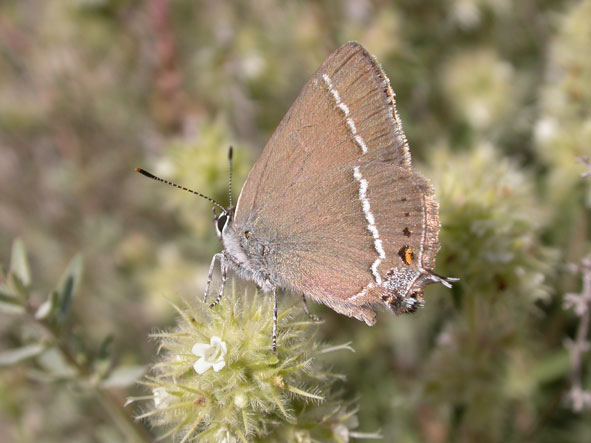
Blue-spotted Hairstreak (Satyrium spini).
Throughout the day, butterfly species were on the wing and several interesting species were noted including Blue-spotted Hairstreak (Satyrium spini) and Panoptes Blue (Pseudophilotes panoptes) were both seen feeding on the spiny flowers of Field Eryngo (Eryngium campestre) whilst several Iberian Scarce Swallowtail (Iphiclides feisthameli) flew rapidly past looking for the larger flowers of the thistle plants.
Panoptes Blue (Pseudophilotes panoptes).
Scarce Swallowtail (Chupaleches / Iphichides podalirius feistameli).
Also seen in good numbers were Common / Southern Blue (Polyommatus icarus / celina) and Long-tailed Blues (Lampides boeticus), Spanish Brown Argus (Aricia cramera), Meadow Brown (Maniola jurtina), Small Heath (Coenonympha pamphilus), Cleopatra (Gonepteryx rhamni), Southern Gatekeeper (Pyronia cecilia) and several species of White including Bath (Pontia daplidice), Small (Artogeia rapae) and Large (Bpieris brassicae).

Tuesday, 23 June 2009

Cattle Egrets, Huetor Tajar, Granada Province.

Unseasonal flock.

Whilst driving towards Granada on the A92 a flock of 17 Western Cattle Egrets (Garcilla Bueyera / Bubulcus ibis) were seen feeding in a harvested Lucerne (Medicago sativa) field near Moraleda de Zafayona. 
This is not an uncommon sight for most of the year, but during the height of summer only the odd singleton is seen.

Tuesday, 16 June 2009

Genil Valley, Sierra Nevada, Granada Province.

Orchids and Butterflies.

Small-leaves Helleborine (Epipactis microphylla).
The main point of this visit was to check on the flowering progress of two species of Epipactis, both growing in the mixed broad leaved woodlands typical of this valley.
The first was Small-leaves Helleborine (Epipactis microphylla) and I quickly found 5 spikes all in different stages of flowering, some starting to go over whilst 2 were still in bud.
Epipactis fageticola.
The next plant was Epipactis fageticola at a site I found last year, where there were 17 spikes with quite a way to go before they were to flower but at a new site to me near the microphylla, 4 more plants were seen in a much brighter position and a single plant had 2 flowers just about open. 
Comma (Polygonia c-album).
4 plus spikes of Dactylorhiza elata ssp sesquipedalis were also in perfect condition a little further along the road in a damp flush.
Long-tailed Blue (Lampides boeticus).
Marsh Fritillary (Euphydryas aurinia).
At a point further down in the valley where the road crosses the Rio Genil several butterfly species were seen, these included Comma (Polygonia c-album), Spanish Gatekeeper (Pyronia bathseba), False Ilex Hairstreak (Satyrium esculi), Small Copper (Lycaena phlaeas), Speckled Wood (Pararge aegeria), Clouded Yellow (Colias croceus), Marsh Fritillary (Euphydryas aurinia), Southern Blue (Polyommatus celina), Small Skipper (Thymelicus sylvestris), Long-tailed Blue (Lampides boeticus), Brown Argus (Aricia agestis), Small White (Artogeia rapae) and Spanish Marbled White (Melanargia ines).

Sunday, 7 June 2009

RAM and Charca de Suárez, Motril, Granada Province.

Strange birds at sea.

Sandwich Tern (Charrán Patinegro / Sterna sandvicensis).
Juan Perez and I made our monthly visit to a headland near Motril to carry out the RAM sea bird survey. The morning was going well with a few Cory (Pardela Cenicienta / Calonectris diomedea) and Balearic Shearwaters (Pardela Balear / Puffinus mauretanicus), Northern Gannet (Alcatraz Atlántico / Morus bassanus) and Audouin's Gulls (Gaviota de Audouin / Larus audouinii) passing by. 
Then the birds of the day were seen moving east about 500 meters offshore, a group of 13 Greater Flamingo's (Flamenco Común / Phoenicopterus ruber) a new bird for my Granada list made quite an unusual sight flying low over the sea. 
A couple of Peregrine Falcons (Halcón Peregrino / Falco peregrinus), Pallid Swifts (Vencejo Pálido / Apus pallidus), Western Cattle Egret (Garcilla Bueyera / Bubulcus ibis), Sandwich (Charrán Patinegro / Sterna sandvicensis), Gull Billed (Charrán Piconegro / Gelochelidon nilotica) and Little Terns (Charrancito Común / Sterna albifrons) were also recorded.

Audouin's Gulls (Gaviota de Audouin / Larus audouinii).
The next stop was at the port of Motril where we spent some time recording the ring numbers of the many Audouin's Gulls roosting.
Charca de Suárez was quiet bird wise but Great Cormorant (Cormorán Grande / Phalacrocorax carbo), Little Grebe (Zapullin Común / Tachybaptus ruficollis), Little Egret (Garceta Común / Egretta garzetta), Grey (Garza Real / Ardea cinerea) and Squacco Herons (Garcilla Cangrejera / Ardeola ralloides) were seen and Western Swamp-hen (Calamon Común /Porphyrio porphyrio) was heard.

Saturday, 6 June 2009

Dragonflies at Charca de Suárez, Granada Province.

Two more new species.

Blue / Common Emperor (Anax imperator).
After the RAM seabird survey Juan and I went to Charca de Suárez near Motril, the wind was strong but several species of Dragonfly were seen. 
The first was a nice ♂ Blue / Common Emperor (Anax imperator) which was sheltering from the winds in some vegetation, a common species at this site and on most areas of water with some marginal plants. 
It is the largest and most powerful flying of the Odonata seen in this region, and some territorial battles between the males are to the death. 
Female Violet Dropwing (Trithemis annulata).
The Emperor was quickly followed by ♂ and ♀ Violet Dropwings (Trithemis annulata) hunting from cut off stalks of Fennel growing along the walk ways around the reserve. 
This species gets its Dropwing name from the position it takes at rest, with the wings thrust forward and down and the abdomen held high. 
Several ♂ Broad Scarlet's (Crocothemis erythraea) were seen and what I first thought was a ♀ of the same species was the next insect to be photographed, but later it was identified as a ♀ Keeled Skimmer (Orthetrum coerulescens) the first of two new dragonfly species seen today. 
 Keeled Skimmer (Orthetrum coerulescens).
I then notice an all black insect with a very active flight skimming low through the vegetation in a drier area of the marsh. 
I again managed to get shots of an Imm ♂, but this was enough to identify it as a Black Percher (Diplacodes lefebvrii) the second new species for me. 
The ♂ was all black, which means it was probably quite an old insect, younger ♂♂ have some yellow markings along the side of the abdomen, it has a restricted range still in Iberia, mainly coastal in the south but is expected to expand north.
Black Percher (Diplacodes lefebvrii).
Iberian Bluetail (Ischnura graellsii) and Small Red-eyed Damselfly (Erythromma viridulum) were also seen along with Migrant Hawker (Aeshna mixta) all of which avoided the camera completely.

Wednesday, 3 June 2009

Sierra de Almijara, Granada Province.

A spectacular show of Marsh Orchids.

The Rio.
After quite a drive out in to the wild's, Jayne and I got to the site where Ian Philips from Malaga had seen Common Twayblade (Listera ovata) and Robust Marsh Orchid (Dactylorhiza eleta) in the past.
Common Twayblade (Listera ovata).
The Marsh Orchid was quite a sight with about 60 spikes growing on the banks of a clear mountain stream with several of the plants reaching a height of near 3 feet and were possibly of the subspecies sesquipedalis
The prize here though were two spikes of the Common Twayblade a new orchid species in Spain for me, they may not be the smartest or brightest Orchid species I have ever seen, but the two spikes were very nice. 
Robust Marsh Orchid (Dactylorhiza eleta).
Usually growing to between 20 and 60 cm, these plants were on the small side at about 30 cms, the spike usually only has two subopposite large oval leaves, but a small third leaf can rarely be present.
Also seen here were Speckled Wood (Pararge aegeria) and Painted Lady (Vanessa cardui) and a very large species of pond skater.

New Damselfly, Sierra de Almijara, Granada Province.

Large Red Damselfly (Pyrrhosoma nymphula).

Male Large Red Damselfly (Pyrrhosoma nymphula).
Several of the Odonata species were on the wing along a small mountain stream in the Sierra de Almijara. I only managed to photograph males but several insects were seen in tandem. This was the only Dragonfly species seen at the site which was surprising as the site looked ideal.