SIERRA de LOJA.

IF YOU ARE LOOKING AT THE BLOG ON A PHONE PLEASE CHANGE TO WEB VIEW AT BOTTOM OF PAGE AS IT WILL LOOK BETTER.

Sunday, 5 May 2013

Charca del Suarez, Granada Province.

A morning of mixed wildlife, included another three year ticks for the bird list.

Mediterranean Chameleon (Chamaeleo chamaeleon).

Juan Perez and I set off from Granada at 06:30 and headed for the area around Charca del Suarez near Motril, our first stop was on the road through the field just North of the main reserve. Straight away we started to see good numbers of both adult and immature Red Avadavats (Bengali Rojo / Amandava amandava), most were feeding on the roadside picking throught the vegetation for seeds but some sat up nicely on the Pampus Grass tussocks and showed well.
Montpellier Snake (Malpolon monspessulanus).
In the areas of thicker cover there were several calling Common Quail (Codorniz Común /Coturnix coturnix), Cetti's Warblers (Ruisenor Bastardo / Cettia cetti), Nightingales (Ruisenor Común / Luscinia megarhynchos) but we could not hear the species I most wanted to see the Savi's Warbler (Buscarla Unicolor / Locustella luscinoides) which Juan had heard a few days earlier. On a semi ruined farm shack there we watched a Hoopoe (Abubilla / Upupa epops) and a Little Owl (Mochuelo Europeo / Athene noctua) have a bit of a stand off, we guessed that both species were breeding in the gapes in the block walls but neither was very happy with their neighbors. We continued on to the junction and again parked and had a bit of a walk around the site listening for the reeling call of the Savi's but we failed to see or even hear the bird during the visit, we did however have very nice views of an immature Montpellier Snake (Malpolon monspessulanus) which was warming its self on the side of the track.
Little Grebe (Zampullín Común / Tachybaptus ruficollis).
The snake was only about 25cm long but it was quite happy to strike at the camera when it had warmed up a bit before heading off into the grass. Along this track we also added both Turtle (Tórtola Europea / Streptopelia turtur) and Collared Doves (Tórtola Turca / Streptopelia decaocto) to the day list along with Spotless Starling (Estornino Negro / Sturnus unicolor), Zitting Cisticola (Buitrón / Cisticola juncidis), Blackbird (Mirlo Común / Turdus merula), House Sparrow (Gorrión Común / Passer domesticus), Greenfinch (Verderón Común / Carduelis chloris), Common Kestrel (Cernicalo Vulgar / Falco tinnunculus), Crested Lark (Cogujada / Galerida cristata), Mallard (Anade Azulón / Anas platyrhynchos) and Reed Warbler (Carricero Común / Acrocephalus scrpaceus). We got back to the road and Juan went and fetched the car so that we could head towards the golf course pools to check what was in this area, we arrived and quickly sorted out Pallid Swift (Vencejo Pálido /Apus pallidus), House Martin (Avión Común / Delichon urbica), White Wagtail (Lavandera Blanca / Montacilla alba), Serin (Verdecillo / Serinus serinus), Yellow-legged Gull (Gaviota Patiamarilla / Larus Michahellis) and Great Tit (Carbonera Común / Parus major).
Squacco Heron (Garcilla Cangrejera / Ardeola ralloides).
We took the track which led down towards the beach via the small pool and reedbed on the golf course, along here we added Common Moorhen (Gallineta Común / Gallinulas chloropus), Little Grebe (Zampullín Común / Tachybaptus ruficollis), Red-rumped Swallow (Golondrina Dáurica / Hirudo daurica), a couple of Whinchat (Tarabilla Nortena / Saxicola rubetra), at least 8 Northern Wheatears (Collalba Gris / Oenanthe oenanthe), Goldfinch (Jilguero / Carduelis carduelis), on the beach a single Kentish Plover (Chorlitejo Patinegro / Charadrius alexandrinus) and out to sea an adult Northern Gannet (Alcatraz Atlántico / Morus bassanus). We then started to make our way back to the car but stopped and cheched out an area of scrub and shrubs which looked good for migrants, almost straight away we located an Olivaceous Warbler (Zarcera Pálido / Hippolais pallida) which was flycatching from some Caster-oil type plants and then a Melodious Warbler (Zarcero Común / Hippolais polyglotta). Before heading to Charca we had a look at the second larger pool on the course and quickly located a Squacco Heron (Garcilla Cangrejera / Ardeola ralloides), Eurasian Coot (Focha Común / Fulica atra) and a Sand Martin (Avión Zapador / Riparia riparia).
Squacco Heron (Garcilla Cangrejera / Ardeola ralloides).
We entered Charca through the back gate with the work party which placed us on the far side of the reserve so we had a look at the hide which looks over the small pool near to the main hide. From here we had the first of a few Western Swamp-hens (Calamon Común / Porphyrio porphyrio), both male and female Little Bitterns (Avetorillo Común / Ixobrychus minutus), several Common Sandpipers (Andarrios Chico / Actitis hypoleucos) and Barn Swallow (Golondrina Común / Hirundo rustica). We later moved around to the main hide and were soon watching a very nice Whiskered Tern (Fumarel Cariblanca / Chilidonias hybridus) which was skimming the pool feeding, Common Pochard (Porrón Común / Aythya ferina), Great Cormorant (Cormorán Grande / Phalacrocroax carbo), Grey Heron (Garza Real / Ardea cinerea), Little Egret (Garceta Común / Egreeta garzetta), a fly over Purple Heron (Garza Imperial / Ardea purpurea) and a squabbling pair of Little Ringed Plovers (Chorlitejo Chico / Charadrius dubius) which flew around the pool but did not land. We then spent some time watching and photographing a nice male Little Bittern which was perched on a log in the water straight out from the hide. After a while we walked out of the hide and spent some time searching the area of planted trees on the edge of the reserve behind the hide, this turned out to be a good move as we soon added a Spotted Flycatcher (Papamoscas Gris / Muscicapa striata) to both our year lists.
Mediterranean Chameleon (Chamaeleo chamaeleon).
We returned to the hide just in time to see the Little Bittern swallowing a very large Iberian Water Frog (Rana Común / Rana Perezi) which I got a couple of shots of. I then left Juan in the hide and went back out to try and get some shots of the Flycatcher but it had gone more distant by the time i found it but I did see my second Olivaceous Warbler of the morning along with a couple of Willow Warblers (Mosquitero Musical / Phylloscopus trochillus), another Melodious and the third year tick for the day a skulking Garden Warbler (Curruca Mosquitera / Sylvia borin). I returned to the hide where Juan was talking with the chap who does the ringing there, he then went out side and found us a fine Mediterranean Chameleon (Chamaeleo chamaeleon) which was happy to have his portrait taken, later I found a second slightly smaller individual which was much less happy to have its photo take and moved higher up in the bush much quicker than expected. While we were watching these beauties several European Bee-eater (Abejaruco Común / Merops apiaster) flew over along with Common Swifts (Vencejo Común / Apus apus).
Turtle Dove (Tórtola Europea / Streptopelia turtur).
After a cracking morning we made our way back to the entrance and out of the reserve and back to Juans car but we did see a couple of Stripe-less Tree Frogs (Hyla meridionalis) on the Iris leaves near the gate. We headed back to Granada and then I headed home, on the way I added Iberian  Magpie (Rabilargo / Cyanopica cooki), Woodpigeon (Paloma Torcaz / Columba palumbus), Jackdaw (Grajilla / Corvus monedula), Woodchat Shrike (Alcaudón Común / Lanius senator) and Tree Sparrow (Gorrión Molinero / Passer montanus). Also during the visit we saw several other species including Blue / Common Emperor (Anax imperator), Red-veined Darter (Sympetrum fonscolombii), Clouded Yellow (Colias croceus), Large White (Pieris brassicae), Painted Lady (Vanessa cardui) and Red Admiral (Vanessa atalanta).

Friday, 3 May 2013

Guadalhorce, Malaga Province.

3 more species for the year list (now 212).

Ringed Plover (Chorlitejo Grande / Charadrius hiaticula).
I arrived at the river mouth and went up on to the bank and down to the sea watch point, straight away I picked up a nice summer plumage Little Egret (Garceta Común / Egreeta garzetta), several Yellow-legged Gulls (Gaviota Patiamarilla / Larus Michahellis) which were flying passed with an adult Lesser Black-backed Gull (Gaviota Sombria / Larus fuscus), Crested Lark (Cogujada / Galerida cristata), Cetti's Warbler (Ruisenor Bastardo / Cettia cetti), Collared Dove (Tórtola Turca / Streptopelia decaocto), several Monk Parakeet (Cotorra Argentina / Myiopsitta monachus) were also calling nosily from the reeds and lots of both Barn Swallows(Golondrina Común / Hirundo rustica) and House Martins (Avión Común / Delichon urbica) filled the air. I then went back down to the car and parked down by the school and went in to the reserve over the main bridge, from the bridge I had more Little Egrets, Eurasian Coot (Focha Común / Fulica atra), Common Moorhen (Gallineta Común / Gallinulas chloropus), Sardinian Warbler (Curruca Cabecinegra / Sylvia melanocephala), Spotless Starling (Estornino Negro / Sturnus unicolor) and Reed Warbler (Carricero Común / Acrocephalus scrpaceus). I then headed to the main hide on the way the Great White Egret (Garceta Grande / Egretta alba) which had been around for some time flew in over the motorway and landed in the tamarisk scrub around the main lake.
Dunlin (Correlimos Común / Calidris alpina).
From the hide it was generally quiet, I did however see several Black-winged Stilts (Ciguenela Común / Himantopus himantopus), Dunlin (Correlimos Común / Calidris alpina), Ringed Plover (Chorlitejo Grande / Charadrius hiaticula), Kentish Plover (Chorlitejo Patinegro / Charadrius alexandrinus), Common Redshank (Archibebe Común / Tringa totanus), Great Cormorant (Cormorán Grande / Phalacrocroax carbo), Sanderling (Correlimos Tridáctilo / Calidris alba), White-headed Ducks (Malvasia Cabeciblanca / Oxyura leucocephala), Black-headed Gulls (Gaviota Riedora / Larus ridibundus) and a male Red-crested Pochard (Pato Colorado / Netta rufina). I then briefly had a look at the next pool round where a very nice pair of European Bee-eaters (Abejaruco Común / Merops apiaster) were showing well in a nearby Shrub Tobacco plant, a couple of fly over Sand Martins (Avión Zapador / Riparia riparia) also gave us good views and along with a fine male Woodchat Shrike (Alcaudón Común / Lanius senator). I took a look at the time and decided to make my way around to the wader hide and pool down by the beach as one of the English guys in the second hide said that there was a Temminck Stint (Correlimos de Temminck / Calidris temminckii) there.
White-headed Duck (Malvasia Cabeciblanca / Oxyura leucocephala).
I passed the first hide along the back by and went straight to the wader scrap, on the muddy margins there were lots of Black-winged Stilts, Dunlins (Correlimos Común / Calidris alpina) and Common Sandpiper (Andarrios Chico / Actitis hypoleucos) and these were accompanied by a few Common Redshank, Ringed Plover, Kentish Plover and singles of both Curlew Sandpiper (Correlimos Zarapitin / Calidris ferruginea) and Bar-tailed Godwit (Aguja Colipinta / Limosa lapponica) but there was no sign of the Stint so I continued on to the pool a little further along the bank, here there were good numbers of all the species at the wader hide plus a single summer plumaged Little Stint (Correlimos Menudo / Calidris minuta), Greenshank (Archibebe Claro / Tringa nebularia), Whimbrel (Zarapito Trinador / Numenius phaeopus), a Spotted Redshank (Archibebe Oscuro / Tringa erythropus), Grey Heron (Garza Real / Ardea cinerea), a couple of roosting Little Terns (Charrancito Común / Sterna albifrons) and in the surrounding Tammarisks there were lots of roosting Turtle Doves (Tórtola Europea / Streptopelia turtur).
Common Redshank (Archibebe Común / Tringa totanus).
I did not see the stint so I started to walk back and just as I was reaching the wader scrap fine Squacco Heron (Garcilla Cangrejera / Ardeola ralloides) flew right over head and into the reeds along the side of the pool, later I watched it fishing whilst giving the Temmincks one last chance from the hide but all I added was a couple of Little Ringed Plovers (Chorlitejo Chico / Charadrius dubius), Melodious Warbler (Zarcero Común / Hippolais polyglotta) and a nice Wood Sandpiper (Andarrios Bastardo / Tringa glareola) which flew in touched the mud for around two seconds and left again. I moved on and had a quick look in the next hide where there were more White-headed Ducks, Common Pochard (Porrón Común / Aythya ferina), Mallard (Anade Azulón / Anas platyrhynchos), a single male Northern Shoveler (Pato Cuchara / Anas clypeata) and some Gadwall (Anade Friso / Anas strepera).
Bar-tailed Godwit (Aguja Colipinta / Limosa lapponica).
I started to make my way back towards the car but went the long way round via the main hide again where the day list grew a little with Gull-billed Tern (Pagaza Piconegra / Gelochelidon nilotica), Northern Wheatear (Collalba Gris / Oenanthe oenanthe), Spanish (Yellow) Wagtail (Lavandera Boyera / Motacilla flava iberiae), a late migrant Sedge Warbler (Carricerin Común / Acrocephalus schoenobaenus), Nightingale (Ruisenor Común / Luscinia megarhynchos), Jackdaw (Grajilla / Corvus monedula), Great Tit (Carbonera Común / Parus major) and Common Kestrel (Cernicalo Vulgar / Falco tinnunculus) all being added. I then went back to the car and went to pick Jayne up in the city.

Tuesday, 30 April 2013

Hacho, Loja, Granada Province.

A couple of new Orchids for a site just up the road.

Iberis pectinata.
Juan Perez and Beartiz came over from Granada and while Beatriz and Jayne did the all important English lesson Juan and I headed up to Hacho which is a small sierra just 5 minute up the road from the house. We parked at the bottom of the track a with Chika we headed up towards the quarry through the mixed woodlands and oak scrub. Stright away we started to find the first of hundreds of Yellow Bee Orchids (Ophrys lutea), a lot of well over with Giant Orchids (Himantoglossum robertiana), a couple of just hanging on Fan-lipped Orchids (Orchis conica) and then the first of the new species, we found a nice group of Pink Butterfly Orchids (Orchis papilionacea).
Biscutella auriculata.
During the walk we must have seen well over a hundred spikes of this fantastic looking plant. Before we reached the pines we also saw good numbers of Sawfly Orchids (Ophrys tenthredinifera) in varying states of flower with some completely over with and a few still in perfect condition, along with these there were a few dried spikes of the early flowering Southern Early Purple Orchid (Orchis olbiensis).
The Wild Peony's (Paeonia broteroi) which were growing under the Oaks were in full flower, as were the carpets of  Tassel Hyacinths (Muscari comosum), Iberis pectinata, Linaria anticaria, Biscutella auriculata, Navel-wort (Omphalodes commutata), Warty Spurge (Euphorbia squamigera), White Rockrose (Helianthemum apenninum), Med Catchfly (Silene colorata), Mediterranean Kidney Vetch (Anthyllis vulneraria) and Grey-leaved Cistus (Cistus albidus).
Pink Butterfly Orchids (Orchis papilionacea).
During this part of the walk we also recorded several birds species including Wren (Chochin / Troglodytes troglodytes), Blackbird (Mirlo Común / Turdus merula), Bonelli's Warbler (Mosquitero Papialbo / Phylloscopus bonelli), Common Chaffinch (Pinzón Vulgar / Fringilla coelebs), Common Kestrel (Cernicalo Vulgar / Falco tinnunculus), Woodpigeon (Paloma Torcaz / Columba palumbus), Spotless Starling (Estornino Negro / Sturnus unicolor), Long-tailed Tit (Mito / Aegithalos caudatus), Great Tit (Carbonera Común / Parus major) and Nightingale (Ruisenor Común / Luscinia megarhynchos).
Linaria anticaria.
We then moved on up through to the Pine woods and again straight away we were finding good numbers of the Pink Butterfly Orchids all the way through this area and right along through the Oak scrub and all the way back down the banks back as far as the car. Also in the pines we found a single spike of Naked / Italian Man Orchid (Orchis italica) and a dozens or so of Ophrys forestieri. Other wildflowers in this area included Field marigold (Calendula arvensis), Yellow Anemone (Anemone palmata) and Rosy Garlic (Allium roseum).
Red-striped Oil Beetle (Berberomeloe majalis).
On the way back down to the car we added Cirl Bunting (Escribano Soteno / Emberiza cirlus), Woodchat Shrike (Alcaudón Común / Lanius senator), Sardinian Warbler (Curruca Cabecinegra / Sylvia melanocephala), Hoopoe (Abubilla / Upupa epops) and Crag Martin (Avión Roquero / Ptyonoprogne rupestris). 

Saturday, 27 April 2013

Laguna Herrera, Malaga Province.

Some wader photography.

Little Bustard (Sisón Común / Tetrax tetrax).
After visiting the site with Chris Pedroza I made my way back to Laguna Herrera after dropping Jayne off in Antequera for a wander around the town. I first took the Southern track and straight away I was seeing and hearing plenty of Calandra Larks (Calandria / Melanocorypha calandra) and Corn Buntings (Triguero / Emberiza calandra), a displaying male Little Bustard (Sisón Común / Tetrax tetrax), a small group of 5 Red-legged Partridges (Perdiz Roja / Alectoris rufa) and the first of quite a few Lesser Kestrels (Cernicola Primilla / Falco naumanni).
Greater Flamingo (Flamenco Común / Phoenicopterus roseus).
I then came to the first area of flooded fields, on the left there were a small group of immature Greater Flamingo's (Flamenco Común / Phoenicopterus roseus), several pairs of Black-winged Stilts (Ciguenela Común / Himantopus himantopus), a winter and a summer plumaged Black-headed Gull (Gaviota Riedora / Larus ridibundus), 4 Greenshank (Archibebe Claro / Tringa nebularia), loads of Wood Sandpipers (Andarrios Bastardo / Tringa glareola) with at least 35 being here and on the flood on the opposide of the track, 2 pairs of Kentish Plovers (Chorlitejo Patinegro / Charadrius alexandrinus) and in the air there were hundreds of Barn (Golondrina Común / Hirundo rustica) and Red-rumped Swallows (Golondrina Dáurica / Hirudo daurica), House Martins (Avión Común / Delichon urbica) and higher up lots of both Common (Vencejo Común /Apus apus) and Pallid Swifts (Vencejo Pálido / Apus pallidus).
Kentish Plover (Chorlitejo Patinegro / Charadrius alexandrinus).
I spent a long time along this stretch of track getting shots of the waders and other species. I then moved around to the main Lagoon, on the way I saw a single Raven (Cuervo / Corvus corax), Common Buzzard (Busardo Ratonero / Buteo buteo), Turtle Dove (Tórtola Europea / Streptopelia turtur), Zitting Cisticola (Buitrón / Cisticola juncidis), Melodious Warbler (Zarcero Común / Hippolais polyglotta) and several singing Reed Warblers (Carricero Común / Acrocephalus scrpaceus). On the verges there was a superb show of wildflowers including a mix of Purple Viper's Bugloss (Echium plantagineum), White Mignonette (Reseda Alba) and Crown Daisy (Chrysanthemum coronarium).
Kentish Plover (Chorlitejo Patinegro / Charadrius alexandrinus).
On the main water there were loads of Eurasian Coots (Focha Común / Fulica atra), a few Mallards (Anade Azulón / Anas platyrhynchos), a couple of male White-headed Ducks (Malvasia Cabeciblanca / Oxyura leucocephala), a dozen or so Great Crested Grebes (Somormujo Lavanco / Podiceps cristatus) and Common Moorhen (Gallineta Común / Gallinulas chloropus).
Corn Bunting (Triguero / Emberiza calandra).
In the air there were good numbers of Gull-billed Terns (Pagaza Piconegra / Gelochelidon nilotica), Barn (Golondrina Común / Hirundo rustica), Red-rumped Swallows (Golondrina Dáurica / Hirudo daurica), House (Avión Común / Delichon urbica) and Sand Martins (Avión Zapador / Riparia riparia) and small number of Alpine Swifts (Vencejo Real / Apus melba) mixed in with hundreds of Pallids and Commons
Barn Swallow (Golondrina Común / Hirundo rustica).
 I had a quick scan across the fields on the left of the track which had almost completly dried out but out on the mud there was a female Marsh Harrier (Aguilucho Lagunero Occidental / Circus aeruginosus) sat plucking some sort of prey. In the same area I picked Spanish (Yellow) Wagtail (Lavandera Boyera / Motacilla flava iberiae), Lesser Black-backed Gulls (Gaviota Sombria / Larus fuscus), Grey Heron (Garza Real / Ardea cinerea) and a Stone Curlew (Alcaraván Común / Burhinus oedicnemus).
Wood Sandpiper (Andarrios Bastardo / Tringa glareola).
I then drove back around to the floods and continued to take more shots of the birds there, new species seen included Northern Lapwing (Avefria Europea / Vanellus vanellus), White Wagtail (Lavandera Blanca / Montacilla alba), Spotless Starling (Estornino Negro / Sturnus unicolor), Goldfinch (Jilguero / Carduelis carduelis) and Linnet (Pardillo Común / Carduelis cannabina).
I later went and picked Jayne up in the town and we went down to the shopping centre where we had a pretty crap lunch in one of the cafes up stairs, did some shopping and then headed home.
Black-winged Stilt (Ciguenela Común / Himantopus himantopus).

Friday, 26 April 2013

Venta del Raya to Zafarraya, Granada Province.

A cracking day at the second attempt !!

Conical Orchid (Orchis conica).
On my way over to Venta del Raya I had a drive through the fields near the house and had notched up just over 30 species of bird before I got to the meeting point including Nightingale (Ruisenor Común / Luscinia megarhynchos), Cetti's Warbler (Ruisenor Bastardo / Cettia cetti), Tree Sparrow (Gorrión Molinero / Passer montanus), Iberian  Magpie (Rabilargo / Cyanopica cooki), Little Ringed Plover (Chorlitejo Chico / Charadrius dubius), Common Sandpiper (Andarrios Chico / Actitis hypoleucos), Woodchat Shrike (Alcaudón Común / Lanius senator) and Spanish (Yellow) Wagtail (Lavandera Boyera / Motacilla flava iberiae).
Aristolochia paucinervis.
A slightly smaller group than on the 20th (as some had Spanish lessons and some were back in the UK) started out from the bar in Venta del Raya and made our first stop at an area of cereal fields where we quickly had some very good views of several Montagu's Harriers (Aguilucho Cenizo / Circus pygargus) including at least 6 fine males and 3 more reserved females. 
Also see whilst at this spot were several calling Turtle Doves (Tórtola Europea / Streptopelia turtur), a couple of Woodchat Shrikes which were perched up on the wires nearby showing well, Iberian  Magpie, Barn Swallow (Golondrina Común / Hirundo rustica), Collared Dove (Tórtola Turca / Streptopelia decaocto) and Mistle Thrush (Zorzal Charlo / Turdus viscivorus). 
We then drove on further down the road towards Zafarraya and pulled off on to a grassed area on the edge of a very nice old Oak woodland.
Sword-leaved Helleborine (Cephalanatera longifolia).
Straight away we started to find the first of hundreds if not thousands of Yellow Bee Orchids (Ophrys lutea) we were to see during the morning. Also found under a nearby Oak was a very nice spike of Sawfly Orchid (Ophrys tenthredinifera) with at least 9 flowers but just the top few were in good condition. 
Out on the fields we saw and heard Corn Bunting (Triguero / Emberiza calandra), Common Cuckoo (Cuco Común / Cuculus canorus), Blackbird (Mirlo Común / Turdus merula) and both Crested (Cogujada / Galerida cristata) and Woodlarks (Totovia / Lullula arborea). 
Deeper into the wooded area we found some very nice Conical Orchids (Orchis conica) which were still in nice condition and varied between almost white through to a strong pink and some equally variable spikes of Fan-lipped Orchid (Orchis conica).
Some of the group.
Wildflowers found included Southern Knapweed (Centaurea pullata ssp pullata), Common Fumitory (Fumaria officinalis), Common Grape Hyacinth (Muscari neglectum), Field marigold (Calendula arvensis), Purple Viper's Bugloss (Echium plantagineum), Southern Daisy (Bellis cordifolia), Southern Red Bartsia (Parentucellia latifolia), Star of Bethlehem (Ornithogalum umbellatum), Warty Spurge (Euphorbia squamigera), Wild Clary (Salvia verbenaca), White Mignonette (Reseda Alba) and Rosy garlic (Allium roseum). 
Once we were in the woods we also started to hear a few more bird species, first was the high pitched calls of both the Short-toed Treecreeper (Agateador Común / Certhia brachydactyla) and Firecrest (Reyezuelo Listado / Regulus ignicapillus) and followed by the musical trill of the summer visiting Bonelli's Warbler (Mosquitero Papialbo / Phylloscopus bonelli). 
In one of the clearings we were watching some Pallid Swifts (Vencejo Pálido /Apus pallidus) flying over high calling nosily when Ann Terry said she had a raptor lower down above the trees, it was climbing rapidly but was easily identifiable as a pale phase Booted Eagle (Aguila Calzada / Aquila penntuas) and whilst we were watching this nice bird a Sparrowhawk (Gavilán Común / Accipiter nisus) soared into view.
Kathy photographing the Helleborines.
We continued on over the clearing seeing a few spikes of Lange's Orchid (Orchis langei) which was not quite in flower, in the next wood we found a good condition Giant Orchid (Himantoglossum robertiana) and some very nice spikes of the beautiful Sword-leaved Helleborine (Cephalanatera longifolia). We then went out on to the road and changed woodland, in the new area we saw many more Conical, GiantYellow Bee and another couple of Sawflys
We soon found a few spikes of the variable Southern Early Purple Orchid (Orchis olbiensis) one of which was growing out of the top of a moss covered rock along with lots of  Rusty-back Fern (Ceterach officinarum) and Little Robin (Geranium Purpureum). 
Out in the flowery meadows a little further on we found a few butterfly species had started to fly including Small Heath (Coenonympha pamphilus), Clouded Yellow (Colias croceus), Painted Lady (Vanessa cardui) and Wall Brown (Lasiommata megera).
Pink Butterfly Orchid (Orchis papilionacea).
We walled back up towards the road and through a large clump of Sword-leaved Helleborines which were just starting to flower nicely. We then crossed over the road into another patch of woodland and started to walk back towards the car, on the way we saw Aristolochia paucinervis, Mediterranean Kidney Vetch (Anthyllis vulneraria), Tassel Hyacinth (Muscari comosum), Wild Peony (Paeonia broteroi), Common Stork's-bill (Erodium cicutarium) and birds included Sardinian Warbler (Curruca Cabecinegra / Sylvia melanocephala), Woodpigeon (Paloma Torcaz / Columba palumbus), European Bee-eater (Abejaruco Común / Merops apiaster) and Common Kestrel (Cernicalo Vulgar / Falco tinnunculus).
We got back to the cars and headed on again for just a short way where we again pulled off the road and started to wander around an area of open Oak woodland which was growing on an exspance of long disused Almond groves. 
Here we quickly located a single plant of Small Woodcock Orchid (Ophrys picta) and several very showy clumps of Pink Butterfly Orchid (Orchis papilionacea) and as we were walking back to the cars a dozen or so spikes of Mirror Orchid (Ophrys speculum subsp speculum). During the walk around this site we had several more Clouded Yellow butterflies, along with Common / Southern Blue (Polyommatus icarus / celina), Bath White (Blanqiverdosa / Pontia daplidice) and a couple of Spanish Festoons (Zerynthia rumina). Birds were hear rather than seen but they did include Orphean Warbler (Curruca Mirlano / Sylvia hortensis), Pied Flycatcher (Papamoscas Cerrojillo / Ficedula hypoleuca), Common Quail (Codorniz Común /Coturnix coturnix), Common Chaffinch (Pinzón Vulgar / Fringilla coelebs) and Red-rumped Swallow (Golondrina Dáurica / Hirudo daurica).
The full group shot.
The group then got back to the cars and we all said goodbye and headed off home, I made a brief stop just a couple of KMs back up the road towards Loja were I found lots more of the Orchids we had all ready seen and added my first ever confirmed Western Dappled White (Euchloe crameri) to my Granada butterfly list. I then headed Home.

Monday, 22 April 2013

Laguna Herrera, Fuente de Piedra, Laguna Dulce, Teba Gorge and Arroya Marin, Malaga Province.

102 species of bird seen on a Day Tour.

Black-winged Stilt (Ciguenela Común / Himantopus himantopus).
I met Chris Pedroza at the very nice hotel Almohalla 51 in Archidona over the border in Malaga Province and we were soon on our way to Laguna Herrera on the old Cordoba road out of Antequera. Once on track down to the site we started to hear the first of a great many  Corn Buntings (Triguero / Emberiza calandra) seen at this site and through out the day. First of all we parked on the side of the track and checked out a flooded field on the right side of the track, straight away we started to see some nice wader species including Black-winged Stilts (Ciguenela Común / Himantopus himantopus), Curlew Sandpiper (Correlimos Zarapitin / Calidris ferruginea), Little Stint (Correlimos Menudo / Calidris minuta), Wood Sandpiper (Andarrios Bastardo / Tringa glareola), Common Redshank (Archibebe Común / Tringa totanus), Little Ringed Plover (Chorlitejo Chico / Charadrius dubius), Kentish Plover (Chorlitejo Patinegro / Charadrius alexandrinus) and Northern Lapwing (Avefria Europea / Vanellus vanellus).
Kentish Plover (Chorlitejo Patinegro / Charadrius alexandrinus).
On the same field we had nice views of Spanish (Yellow) Wagtail (Lavandera Boyera / Motacilla flava iberiae), Zitting Cisticola (Buitrón / Cisticola juncidis), Crested Lark (Cogujada / Galerida cristata), Common Stonechat (Tarabilla Común / Saxicola torquata) and in the gully amongst the reeds we added Reed Warbler (Carricero Común / Acrocephalus scrpaceus), Common Moorhen (Gallineta Común / Gallinulas chloropus) and above us there were a couple of Short-toed Larks (Terrera Común / Calandrella brachydactyla), along with masses of Barn (Golondrina Común / Hirundo rustica) and Red-rumped Swallows (Golondrina Dáurica / Hirudo daurica), House Martins (Avión Común / Delichon urbica), both Pallid (Vencejo Pálido /Apus pallidus) and Common Swifts (Vencejo Común / Apus apus) and to finish a group of three cracking Honey Buzzards (Aberjero Europeo / Pernis apivorus) which were pushing through North.
Kentish Plover (Chorlitejo Patinegro / Charadrius alexandrinus).
We then had a scan over the main Laguna where we soon located Eurasian Coots (Focha Común / Fulica atra), Great Crested Grebe (Somormujo Lavanco / Podiceps cristatus), Mallard (Anade Azulón / Anas platyrhynchos) and a couple of male White-headed Ducks (Malvasia Cabeciblanca / Oxyura leucocephala). In the air there were large numbers of Gull-billed Terns (Pagaza Piconegra / Gelochelidon nilotica) calling noisily as they were feeding between the two areas of water. We then made a move along the track getting good views of a Common Sandpiper (Andarrios Chico / Actitis hypoleucos), a nice pair of summer plumage Black-necked Grebes (Zampullín Cullinegro / Podiceps nigricollis), a flock of around 40 or so Greater Flamingo's (Flamenco Común / Phoenicopterus roseus) which flew out from the flooded fields on the right, circled around and dropped back in again. In the flock there was just a single immature bird which stuck out like a sore thumb, when we checked the flood from the far end we found another 15 or so Immature birds in a separate flock from the adults.
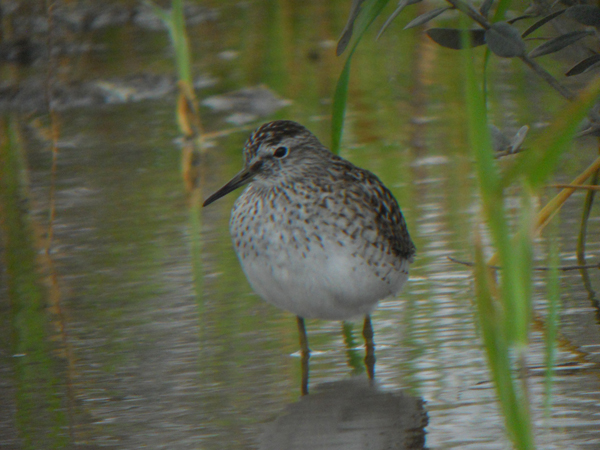
Wood Sandpiper (Andarrios Bastardo / Tringa glareola).
Whilst we were up on the bank we also picked up a single Common Buzzard (Busardo Ratonero / Buteo buteo) sat on a pylon and a group of fly over European Bee-eaters (Abejaruco Común / Merops apiaster) and all the time we walked along the bank there were dozens and dozens of newly emerged Red-veined Darters (Sympetrum fonscolombii) coming up out of vegetation.
The plants on the bank included White Mustard (Sinapis alba), Warty Spurge (Euphorbia squamigera), Small Melilot (Melilotus indica), White Mignonette (Reseda Alba), Pink Med Catchfly (Silene colorata), Pitch Trefoil (Psoralea bituminosa), Purple Viper's Bugloss (Echium plantagineum), Scentless Mayweed (Matricaria perforata), Scarlet Pimpernel (Anagallis arvensis), Common Fumitory (Fumaria officinalis), Mallow-leaved Bindweed (Convolvulus althaeoides), Common Poppy (Papaver rhoeas) and Eruca (Eruca sativa).
We continued on around the site into the fields and took the left turn back towards the main road, near the junction we saw a pair of Ravens (Cuervo / Corvus corax) on another pylon, Lesser Kestrel (Cernicola Primilla / Falco naumanni) and a pair of Red -rumped Swallows which gave us cracking views as they entered a colvert along side the road. We continued on a short way and found the fields on both sides of the road were flooded and held good numbers of birds included 30+ Wood Sandpipers which was by far the largest number I have seen at a single site locally, 3 more Curlew Sandpipers, dozens of Black-winged Stilts, several Avocets, 5 or 6 Greenshanks (Archibebe Claro / Tringa nebularia), Gull-billed Terns, Black-headed Gulls (Gaviota Riedora / Larus ridibundus) and a Little Egret (Garceta Común / Egreeta garzetta).
Barn Swallow (Golondrina Común / Hirundo rustica).
A little further along the same track we had several singing Calandra Lark (Calandria / Melanocorypha calandra) and a single male Little Bustard (Sisón Común / Tetrax tetrax) which was displaying in a distant field. We then jumped back on to the A92 and headed to our second site at Fuente de Piedra, on the entrance road we scanned the pool on the left where we had some more Black-winged Stilts, Avocets, a couple of Wood Sandpipers and a female type Ruff (Combatiente / Philomachus pugnax). We parked and then walked out on the board walk and on to the raised back over looking the main lagoon, here we added Common Pochard (Porrón Común / Aythya ferina), Gadwall (Anade Friso / Anas strepera), Northern Shoveler (Pato Cuchara / Anas clypeata) and out on the main area of water there were loads of Greater Flamingo's, good numbers of Black-necked Grebes and a few immature Lesser Black-backed Gulls (Gaviota Sombria / Larus fuscus). We turned around and walked back towards the visitors centre, on the way we had views of a female Marsh Harrier (Aguilucho Lagunero Occidental / Circus aeruginosus), an immature Yellow-legged Gull (Gaviota Patiamarilla / Larus Michahellis) and another single Wood Sandpiper.
Corn Bunting (Triguero / Emberiza calandra).
Once back on the main track we went around the back of the centre to look at the hides, on the way a calling Great Spotted Cuckoo (Crialo Europeo / Clamator gladarius) landed in a distant willow tree and then flew back towards us and straight over our heads giving great views. In the small open hide over looking the first small pool we heard a couple of Cetti's Warbler (Ruisenor Bastardo / Cettia cetti), Serin (Verdecillo / Serinus serinus), Greenfinch (Verderón Común / Carduelis chloris), Reed Warbler (Carricero Común / Acrocephalus scrpaceus) and a calling Little Owl (Mochuelo Europeo / Athene noctua). In the pool there were lots of Stripe-necked Terrapins (Mauremys leprosa) and crooking Iberian Water Frogs (Rana Común / Rana Perezi) along with a couple of Lesser Emperors (Anax parthenope) and more Red-veined Darters. We then moved on to the main large hide and straight a way we found fine male Red-crested Pochard (Pato Colorado / Netta rufina), later we located several more including a couple of females. Also on the pool we had Little Grebe (Zampullín Común / Tachybaptus ruficollis), more Avocets, Black-winged Stilts, Black-headed Gulls but not a lot else.
Black-necked Grebes (Zampullín Cullinegro / Podiceps nigricollis).
We moved around to the next hide on the way we had nice views of a male Sardinian Warbler (Curruca Cabecinegra / Sylvia melanocephala) which was singing from a nearby bush, from the hide we did not see anything. On our way back around the center we saw a Jackdaw (Grajilla / Corvus monedula) going into a nest hole in the wall of the center.
Once we were back into the car we started the drive around the eastern side of the lake to the view point which over looks a largish pool surrounded by largish reed beds, here we could hear Great Reed Warbler (Carricero Tordal / Acrocephalus arundinaceus), Nightingale (Ruisenor Común / Luscinia megarhynchos) and watched a flock of nine Ravens soaring together over a nearby hill side covered in the purple flowers of Bugloss. On the lake there were more Gull-billed Terns, Common Pochard, a couple of Grey Herons (Garza Real / Ardea cinerea) and a single Western Swamp-hen (Calamon Común / Porphyrio porphyrio).
Bugloss.
We moved on from here and headed to Laguna Dulce where we had our lunch in the hide whilst watching a trio of beautiful Grebe species, the Black-necked Grebes were the finest in their summer plumage but close on the looks front came both the Great Crested and Little Grebes which were both seen just in front of the hide. Off to the left there were several White-headed Ducks and a single female Red-Knobbed Coot (Focha Moruna / Fulca cristata). Also on the lake we picked up two Whiskered Terns (Fumarel Cariblanca / Chilidonias hybridus), Red-crested Pochards and Blue / Common Emperor (Anax imperator).
We again moved site and headed towards Teba stopping at the Sierra and then at the gorge, here we added a few new species including a Griffon Vulture (Bultre Leonado / Gyps fulvus) which soared around above the crags whilst being mobbed by a group of Red-billed Choughs (Chova Piquirroja / Pyrrhocorax pyrrhocorax) and above the cliffs there were good numbers of both Pallid and Alpine Swifts (Vencejo Real / Apus melba).
Bugloss.
From the crags we moved to the bridge which over looks the gorge and straight away we had more Alpine Swifts, good numbers of Crag Martins (Avión Roquero / Ptyonoprogne rupestris), Rock Pigeon (Paloma Bravia / Columba livia), Woodpigeon (Paloma Torcaz / Columba palumbus), Collared Dove (Tórtola Turca / Streptopelia decaocto), Woodchat Shrike (Alcaudón Común / Lanius senator) and a Thekla Lark (Cogujada Montesina / Galerida theklae). We also had a few butterflies at the site including Clouded Yellow (Colias croceus), Southern Blue (Polyommatus celina), Large White (Pieris brassicae), Painted Lady (Vanessa cardui) and Red Admiral (Vanessa atalanta).
There were also lots wildflowers here, some of the showiest were Common Snapdragon (Antirrhinum major), White Snapdragon (Antirrhinum controversum), Wild Clary (Salvia verbenaca), White Mignonette (Reseda Alba), White Mustard (Sinapis alba), White Rockrose (Helianthemum apenninum), Star of Bethlehem (Ornithogalum umbellatum), Tassel Hyacinth (Muscari comosum), Pitch Trefoil (Psoralea bituminosa), Purple Viper's Bugloss (Echium plantagineum), Bellardia trixago, Linaria hirta and Navel-wort (Omphalodes commutata).
At Laguna Dulce.
From here we started to make our way back towards Archidona, on the way we had the only Montagu's Harrier (Aguilucho Cenizo / Circus pygargus) of the day which was a fine 1st summer male, considering the habitat we had been in for most of the day I was surprised we only had a single bird of this species.
We went through Archidona and dropped down to our last stop of the day which was down in the wooded valley of the Arroyo Marin. We parked near the quarry at the entrance to the valley and walked on, straight away we had Nightingale singing all around us and a nice male Serin singing from the dead branches of a tree right over our heads. I then heard both Iberian Green Woodpecker (Pito Real / Picus sharpei) and Wryneck (Torcecuello / Jynx torquilla) in quick succession but Chris missed both of them and they remained silent of the rest of our time at the site. We continued on and within a few seconds had added Melodious (Zarcero Común / Hippolais polyglotta), Orphean (Curruca Mirlano / Sylvia hortensis) and Bonelli's Warblers (Mosquitero Papialbo / Phylloscopus bonelli) to the day list. Blackcap (Curruca Capirotada / Sylvia atricailla), Great Spotted Woodpecker (Pico Picapinos / Dendrocopos major), Great (Carbonera Común / Parus major), Blue (Herrerillo Común / Parus caeruleus) and Long-tailed Tits (Mito / Aegithalos caudatus) soon followed along with Short-toed Treecreeper (Agateador Común / Certhia brachydactyla), Iberian  Magpie (Rabilargo / Cyanopica cooki), Pied Flycatcher (Papamoscas Cerrojillo / Ficedula hypoleuca), Wren (Chochin / Troglodytes troglodytes), Robin (Petirrojo Europeo / Erithacus rubecula) and Common Chaffinch (Pinzón Vulgar / Fringilla coelebs).
Chris at Teba Gorge.
We then retraced our steps back to the car and we returned to the Hotel up in Archidona where we had a coffee to finish the day and while we sat out side we had a Short-toed Eagle (Culebrera Europeo / Circaetus gallicus) fly over, a great way to finish what had already been a great day. Thanks Chris for your company and for supporting Granada Wildlife.